
An AI receptionist for small business answers your phone when you can’t: it greets the caller, answers the common questions, books the appointment or takes the message, and hands the rest to a human. That part every vendor demos well. What none of the pages ranking for this search will do is tell you what one actually costs at your call volume, because each vendor bills in a different unit and only prices its own.
So I did the math. I read the public pricing pages of four providers on October 10, 2026, one for each billing model you’ll run into: per minute, per call, per unique caller, and raw pay-as-you-go infrastructure. Then I priced the same three small businesses on all four. Same calls, same minutes. For the busiest one, the cheapest bill came out at $155 a month and the most expensive at $1,640. That’s a 10x gap for the same phone traffic, and the reason is almost entirely the billing model, not the AI.
Disclosure first, because it matters here. I sell AI consulting and done-for-you builds. I run a fleet of autonomous agents across 10+ brand containers that write this site, answer its inbox and log their own failures. I don’t run a phone line in that fleet, and I haven’t put any of these four vendors on a real business number. Everything below about their pricing is read from their own pages, not tested. Where I do have first-hand receipts is the part that decides whether any AI receptionist works: what it does with the conversation it shouldn’t handle. My email agent faces that question 500 times a month, and I’ll show you its numbers.
Here’s what you’ll get: what the job actually is, the three billing models, a cost table for three real call profiles, what you’re buying from a reseller, why escalation is the real product, how to check it in week one, and an FAQ.
What an AI Receptionist for Small Business Actually Does (and the Part Nobody Demos)

Strip away the marketing and every AI receptionist for small business does four jobs. It answers (picks up on the first ring, 24/7, in a voice that doesn’t sound like a 2015 phone tree). It informs (hours, prices you’ve approved, service area, “do you take my insurance”). It captures (books into your calendar, or takes a structured message with name, number and reason). And it routes (sends the caller to a human when the call is beyond it).
The first three are where the demos live, and honestly, they’re mostly solved. Modern voice models handle “can I book Thursday at 3” without drama. The fourth job is where small businesses get burned, because it’s the one you can’t see in a two-minute demo call. The vendor shows you the happy path. Your real callers bring the angry customer, the billing dispute, the person who wants a price you’ve never quoted, and the caller who needs you, specifically, right now.
That’s why the useful question isn’t “how good is the voice?” It’s three plainer ones:
- What does it cost at my volume? (Sections 2 and 3.)
- Who owns the setup if I leave? (Section 4.)
- What happens on the call it can’t handle? (Section 5.)
If you’re still deciding whether to automate the phone at all, versus the inbox or the calendar, my piece on replacing a virtual assistant with AI walks through which tasks transfer cleanly and which don’t. Phones sit in the middle: high volume, very repetitive, and with a small tail of calls that matter a lot.
Three Billing Models, Three Different Bills
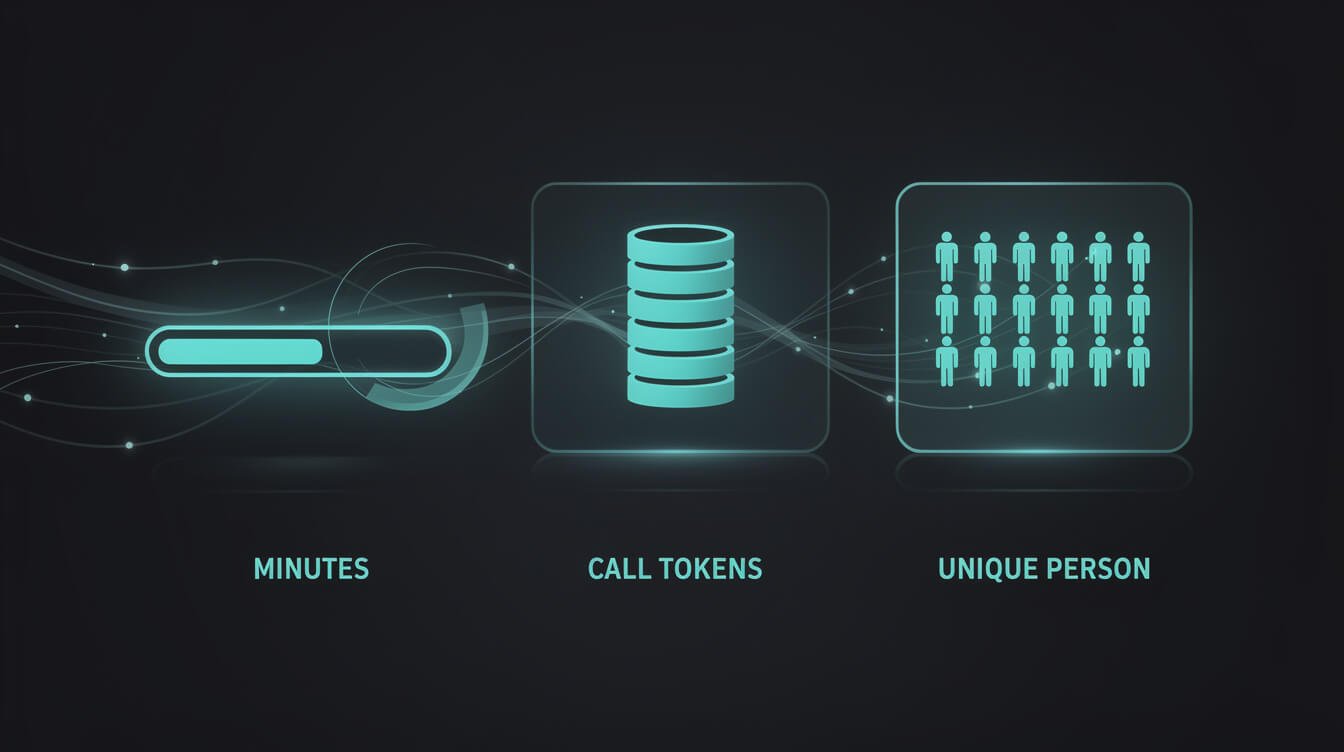
Before you compare vendors, compare how they count. Every AI receptionist for small business I looked at bills in one of these units, and the unit decides who wins at your volume far more than features do.
Per minute: Dialzara
Dialzara sells buckets of talk time. Business Lite is $29/month for 60 minutes (then $0.48/min), Pro is $99 for 220 minutes ($0.45 overage), Plus is $199 for 500 minutes ($0.40), and Elite is $349 for 1,000 minutes ($0.35). One detail matters more than the price: on Lite, transfers are blind only. Warm transfer, where the AI briefs your team member before connecting, starts at Pro. Per-minute billing is easy to understand and punishes long calls.
Per call: Smith.ai
Smith.ai’s AI Receptionist counts calls, not minutes. Free covers 25 calls ($3.00 each after). Pro is $150/month for 75 calls ($2.50 per extra call), with higher tiers at $270 for 150 ($2.30 extra), $500 for 300 ($2.17 extra) and $800 for 500 ($2.10 extra), plus custom pricing above 1,000. Smith.ai’s own FAQ argues that per-minute vendors “want to maximize your call length while you want to minimize your call time.” The other side of that: a 20-second wrong number costs the same as a 9-minute booking. Spam counts by default; they filter known spam numbers automatically and let you remove up to 10% of calls from each bill.
What you’re paying the premium for is stated plainly: if the AI can’t handle a call, it can transfer to a live North America-based receptionist, any time. That’s a different product from the other three, and I’ll price it as one.
Per unique caller: Goodcall
Goodcall bills by how many different people call. Starter is $79/month for 100 unique customers (then $0.79 each), Growth is $129 for 500 ($0.26 each), Scale is $299 for 2,000 ($0.15 each). A unique customer is “one phone number, once a month,” so a regular who calls five times in March counts once, and spam and wrong numbers don’t count at all. No minutes are metered. Lower tiers limit the number of “workers” (specialist skills), connected tools and call history (30 days on Starter).
Raw infrastructure: Retell AI
Retell isn’t a receptionist you buy. It’s the voice platform developers and agencies build receptionists on. Pay-as-you-go runs $0.07 to $0.31 per minute depending on the language model and voice you pick. Its own estimator’s default works out to $0.15/min (model $0.08 + voice infrastructure $0.055 + speech $0.015), and US phone service adds $0.015/min. New accounts get $10 in free credits. Keep this number in mind for Section 4, because it’s what a lot of “AI receptionist” resellers are paying underneath.
For a benchmark on the human side, Goodcall’s pricing FAQ puts a live answering service at “about $1.50 to $1.90 a minute.” That’s a vendor’s figure about its competitors, so treat it as a rough anchor, not a quote.
The Real Cost Table: Three Small Businesses, Same Calls, Four Bills

Here’s what an AI receptionist for small business costs across three typical call profiles. I’ve stated every assumption so you can redo the math for yours. For each vendor I picked the cheapest plan that covers the volume, including overage where overage was cheaper than the next tier.
- A, solo trades (plumber, electrician, mobile groomer): 120 calls/month, 3 minutes average = 360 minutes, about 100 different callers.
- B, busy shop or salon: 400 calls/month, 2.5 minutes average = 1,000 minutes, about 300 different callers.
- C, multi-provider clinic or office: 900 calls/month, 4 minutes average = 3,600 minutes, about 600 different callers.
| Monthly bill | A: Solo trades | B: Busy shop | C: Clinic |
|---|---|---|---|
| Dialzara (per minute) | $162 (Pro: $99 + 140 min × $0.45) | $349 (Elite, 1,000 min included) | $1,259 (Elite: $349 + 2,600 min × $0.35) |
| Smith.ai (per call, human backup) | $262.50 (Pro: $150 + 45 × $2.50) | $717 ($500 tier + 100 × $2.17) | $1,640 ($800 tier + 400 × $2.10), or a custom quote |
| Goodcall (per unique caller) | $79 (Starter, 100 included) | $129 (Growth, 500 included) | $155 (Growth: $129 + 100 × $0.26) |
| Retell (raw, before anyone builds it) | ~$59 (360 min × $0.165) | ~$165 | ~$594 |
Three things jump out.
1. The unit decides the winner. Goodcall is cheapest in all three profiles here, but only because these profiles have a lot of repeat callers and long-ish calls. Flip the assumptions and the order shifts. A lead-gen business where every caller is a new person pays Goodcall per call in practice. A business with 45-second calls (“are you open Sunday?”) makes per-minute billing look great.
2. Smith.ai isn’t overpriced; it’s a different product. It’s the only one of the four with a live human safety net built in. If a botched call costs you a $3,000 job, the $2 per call is cheap insurance. If your calls are mostly “what are your hours,” it’s expensive.
3. Volume growth is where bills surprise you. Going from profile B to C, Dialzara’s bill rises 3.6x and Smith.ai’s 2.3x, while Goodcall’s barely moves. Before you sign, price next year’s volume, not this month’s.

Get the AI Playbook
The operator notes behind posts like this one: how the fleet is wired, what each agent is allowed to touch, and what broke last week. Free, and you can leave whenever you like.
The Reseller Layer: What You’re Buying When a Local Agency Sells You One

Look at who else ranks for this search. Two of the top four results are YouTube videos for sellers: one titled “Sell AI Receptionists To Local Businesses (Watch Me Sell One),” another showing how to build an AI voice receptionist for local businesses. There’s a whole cottage industry of new agencies packaging an AI receptionist for small business owners, and Dialzara’s pricing page has a white-label partner program built for exactly that.

⚡ GET THE AI EDGE
Weekly AI tips that actually save you time and money. No fluff, no hype — just what works.
That’s not automatically bad. A good reseller does the part most owners don’t want to do: writing the call script, wiring your calendar, testing the edge cases. But you should know what’s under the hood. If an agency charges $400/month for a receptionist built on a platform like Retell, and your shop runs about 1,000 minutes a month, the raw platform cost underneath is roughly $165. The other $235 is their margin for setup, hosting and fixes. That’s a fair trade if they actually do the fixes. It’s a bad one if the agency vanishes after month two.
So before you sign with any reseller, ask them to put three things in writing:
- Who owns the phone number? If it’s provisioned in their account, leaving them can mean losing the number your customers have saved.
- Can I export the script, knowledge base and call recordings? If the answer is “it’s in our platform,” you’re renting, not buying.
- What’s the response time when it breaks? “We’ll look into it” isn’t an answer. A number of hours is.
This is the same ownership test I use for any automation build, and it’s why I wrote about the difference between renting a managed service and commissioning a build you own. If you want a second opinion on a receptionist quote, or you’d rather have one built where you own the number, the script and the recordings, that’s the kind of thing I do in a strategy session. Bring the quote.
The Call It Can’t Handle: Why Escalation Is the Real Product

Here’s where I can show you receipts instead of pricing pages. I don’t run a receptionist, but I run an AI agent that triages my business inbox twice a day, and it faces exactly the question every AI receptionist faces: should I answer this, or hand it to a human?
Over the 30 days to October 10, 2026, it ran 60 times. Across the 59 runs that logged a result, it processed 511 inbound emails. It drafted replies to 5. It classified 61 as money (invoices, charges, payment notices), and its rules forbid it from replying to any of those, so they go to a human instead. Another 433, about 85%, were noise: automated notifications from other services that needed a label, not a reply.
Read those numbers as a receptionist designer would. The agent’s value wasn’t the 5 replies. It was not replying to the other 506, and making sure the 61 that touched money reached a person. Its hardest-coded rule is one line: never make commitments, pricing decisions or agreements on the owner’s behalf. Your AI receptionist needs the same line, and you need to check it holds.
Translate that to your phone:
- Write the “never” list before the script. Never quote a price you haven’t approved. Never promise a time slot without checking the calendar. Never discuss a bill or a complaint beyond taking the details. Every vendor lets you write these rules; few owners do.
- Pick warm transfer for anything with money or emotion in it. A blind transfer drops the caller on whoever picks up, with no context. A warm transfer briefs them first. On Dialzara that’s the difference between Lite and Pro; on Smith.ai it can go to their live team.
- Decide what “urgent” means, in writing. Burst pipe, lockout, a patient in pain. Those should ring your mobile, not land in a summary email you’ll read tonight.
- Know your noise share. My inbox is 85% noise. Your phone won’t be that high, but it won’t be zero, and the billing models treat it differently: Goodcall doesn’t count spam or wrong numbers, Smith.ai counts spam unless it’s filtered or you remove it (up to 10%).
I wrote a longer piece about what my AI agents can’t do. The pattern is the same here: the failures that hurt are rarely the AI misunderstanding a sentence. They’re the AI confidently handling something it should have handed off.
Week One: How to Check Your AI Receptionist Is Actually Working
Every vendor gives you a dashboard. “Calls handled: 142.” That number tells you the system picked up. It doesn’t tell you it did the right thing. I learned this the expensive way in my own fleet: my social scheduler reported success on every post for weeks, and only when I read back what was actually stored did I find it had silently set a public flag to the wrong value on all of them. A success screen is not the same as the outcome. I now call it verifying the thing that leaves the building.
For an AI receptionist for small business, the thing that leaves the building is the call. Here’s the week-one routine I’d run:
- Call it yourself, five times, as five different callers. Book something. Ask for a price it shouldn’t know. Get angry. Ask for “the owner.” Call at 2 a.m. Write down what happened each time.
- Listen to 10 real recordings. Every vendor above keeps some form of call history, recordings or transcripts. Pick them at random, not from the summary’s highlights. You’re looking for the call where it sounded confident and was wrong.
- Check the bookings landed. Open your actual calendar and match five AI bookings to five calls. A booking the AI said it made but your calendar never received is the worst possible failure, because the customer shows up.
- Test the notification path. Trigger an urgent call and time how long it takes to reach your phone. My own alert script is written to report success even when it has no credentials to send with, so its “OK” proves nothing on its own. Assume your vendor’s notifications can fail just as quietly until you’ve seen one arrive.
- Read one month’s bill against your own count. Whatever unit you’re billed in (minutes, calls, unique callers), count a week yourself and compare. You’ll learn your real call profile, which is the number Section 3 needs.
Then do a lighter version monthly; an AI receptionist for small business isn’t a set-and-forget purchase. Agents drift as your services, prices and hours change, and a script that was right in October can be quietly wrong by March. My outcome audit of my quietest agent is a good template: the agent that never complains is the one to check first.
AI Receptionist for Small Business: Frequently Asked Questions
How much does an AI receptionist for small business cost?
From roughly $29 to several hundred dollars a month for most small businesses, but the real answer depends on your billing unit and volume. In my three profiles (120 to 900 calls a month), bills ran from $59 (raw Retell, before anyone builds it) to $1,640. Price your own volume, and next year’s, before comparing.
Is an AI receptionist cheaper than a human answering service?
Usually, by a lot, for routine calls. Goodcall puts live answering at about $1.50 to $1.90 a minute (their figure); at 360 minutes a month that’s $540 to $684, against $79 to $262.50 for the three ready-made AI options in profile A. The gap narrows if you need a human on hard calls, which is exactly what Smith.ai’s higher per-call price buys.
Will callers know they’re talking to AI?
Many won’t notice on a simple booking, and some will. Whether you tell them is a decision worth making on purpose, not by default. Recording-consent and AI-disclosure rules vary by location, so check yours before you go live. My own view: a one-line greeting that says it’s an AI assistant costs you almost nothing and earns trust.
Can an AI receptionist book appointments into my calendar?
Yes. Calendar sync is standard on the mid-tier plans (on Dialzara it starts at Pro, on Smith.ai it’s included from Free via tools like Calendly). Verify it with real bookings in week one; don’t trust the confirmation the AI reads to the caller.
Should I build my own on a platform like Retell instead?
Only if you or someone you pay will maintain it. The raw cost is low (about $165 a month for 1,000 minutes in my estimate), but you own the script, the testing, the updates and the 2 a.m. outage. If you want to understand that build-versus-hire trade properly, I wrote a full guide on when to hire AI developers and what it costs.
What’s the biggest mistake small businesses make with these?
Writing the happy-path script and skipping the “never” list. The AI will handle a booking fine. The damage comes from a confident answer to a question it should have handed to you.
Final Thoughts: Pick the Billing Model, Then the Vendor
Choosing an AI receptionist for small business feels like a feature comparison, but the data says it’s mostly a math problem and an escalation problem. Get your real call profile: calls a month, average length, how many different people. Run it through each billing model. Then decide how much a mishandled call costs you, because that decides whether you need a human backup or just a good warm transfer.
Do those two things and the vendor choice mostly makes itself. Skip them and you’ll pick on voice quality, which is the one thing they all do well now.
And whichever you pick, spend an hour in week one calling it yourself and listening to the recordings. The dashboard will tell you it’s working. The recordings will tell you whether that’s true.
Before You Sign Anything, Get the Playbook
The Lead Magnet AI Playbook: the rules, checklists and escalation lists I use to keep unattended agents from saying the wrong thing to a customer. Free, no fluff.
📥 FREE: THE AI PLAYBOOK
The exact tools and workflows I use to run a one-person agency. 25 years of marketing experience distilled into an actionable guide. Yours free.

AI & Digital Marketing Strategist
With over 25 years in digital marketing, e-commerce, sales, and international business, Jon Jones is a seasoned entrepreneur dedicated to empowering small businesses through innovative AI solutions. His journey began in investment banking on Wall Street, guiding companies through capital acquisition and complex markets, and has expanded to include expertise in web development, brand design, product development, and courses and training.
Fluent in Mandarin and with a rich foundation in both finance and tech, Jon launched JonJones.ai to provide accessible, transformative tools for small businesses to streamline operations, generate leads, and build sustainable growth. His mastery of AI, automation, and digital strategy has enabled numerous businesses to bridge the gap between traditional practices and modern technology, ensuring they thrive in today’s digital landscape.