
Here’s something that should make you uncomfortable if you run a consulting practice: IBM has deployed AI agents across 160,000+ consultants. McKinsey, BCG, and Bain are automating what used to take junior analysts weeks of work. The research and analysis that powered six-figure retainers? AI and consulting are now deeply intertwined — and the firms that move fastest will set the new pricing floor.
So what does this mean for you as a solopreneur or indie consultant?
It means the playbook just changed — and operators who move fast are about to have an unfair advantage that the big firms can’t easily replicate. This guide breaks down exactly what the intersection of AI and consulting looks like in 2026: what’s being automated, what still requires humans, and how to position yourself to win before the window closes.
What AI Is Actually Doing to the Consulting Industry Right Now

The AI transformation in consulting isn’t a prediction — it’s already running at scale in the enterprise. Let’s get specific, because the numbers change how you think about your positioning.
IBM has deployed AI agents to over 160,000 consultants, automating the repetitive research, analysis, and documentation tasks that used to consume junior analyst hours. McKinsey has built proprietary AI tools that can generate market sizing models, competitive landscapes, and initial strategic hypotheses in hours rather than weeks. BCG has gone public about AI reducing certain project timelines by 30-50%. Bain is running AI pipelines for data synthesis on every major engagement.
What’s being automated at the enterprise level is instructive:
- Market and competitor research — pulling, synthesizing, and formatting data from dozens of sources
- Initial hypothesis generation — building first-cut strategic options from industry data
- Report drafting — first-pass slide decks, executive summaries, analysis memos
- Data analysis — pattern recognition across large datasets, financial model first drafts
- Meeting prep and follow-up — briefing documents, action item tracking, stakeholder communication
Notice what’s not on that list: strategic judgment, client relationship management, organizational politics navigation, change management facilitation, implementation oversight. Those remain stubbornly human — and they’re exactly where the value concentration is shifting.
The implication isn’t that big consulting firms are getting weaker. It’s that the cost structure that justified large teams is eroding. A McKinsey engagement used to cost $500K+ partly because of analyst-hours embedded in the price. AI is gutting that cost driver — but slowly, because large firms move slowly. The faster implication is that the value has shifted from research and analysis capacity to strategic judgment — and that’s where a solo operator with the right AI stack competes on equal footing.
If you want a deeper look at how agentic AI systems are driving this shift at the infrastructure level, the complete guide to agentic AI for solopreneurs covers the architecture behind what the big firms are deploying — and how you can run equivalent systems on a $200/month stack.
The Solopreneur’s Unfair Advantage in the AI Era

Big consulting firms have a structural problem that solopreneurs don’t: they move slowly, and AI adoption is fastest for those who can move the fastest.
Before a McKinsey analyst can use a new AI tool, it goes through procurement review, IT security approval, partner sign-off, client contract terms review, and a change management rollout. That process takes six to eighteen months at most major firms. You can adopt a new tool today — and have it integrated into your workflow by tomorrow.
This is the structural leverage that AI hands to solo operators. Here’s what it looks like in practice:
Speed of adoption. When Claude released its Projects feature — persistent memory and document uploads that maintain full client context across sessions — I had it integrated into my client workflow within a day. A firm with 10,000 consultants needs months to standardize this across compliance, IT, and client agreements. You used it this week.
Cost structure. You have no overhead. No office rent, no benefits, no HR, no equity grants. Your AI tools cost $150-300 per month, not $500K in analyst salaries. That means you can either compete on price while maintaining higher margins than a large firm — or compete on quality and delivery speed at a comparable price point. You choose.
Depth of integration. Because you’re running the tools yourself, you can tune them to your specific client contexts. Large firms deploy AI at scale, which means they lose the customization that makes AI genuinely powerful. You can maintain client-specific prompts, context files, and research pipelines that a firm deploying tools to thousands of consultants literally cannot replicate with the same precision.
Client proximity. You’re never more than one conversation away from your client. At a large firm, the junior analyst who runs the research never talks to the client. You’re the analyst and the partner simultaneously — AI-augmented. The contextual intelligence you bring to every deliverable because you’re in every meeting is something no amount of AI deployment at scale can replicate.
The bottom line: AI has commoditized the research and analysis work that justified large consulting teams. What’s left — judgment, relationships, trust, execution expertise — is exactly what the solo operator provides by default. This is your era.
5 Consulting Tasks You Should Already Be Handing to AI
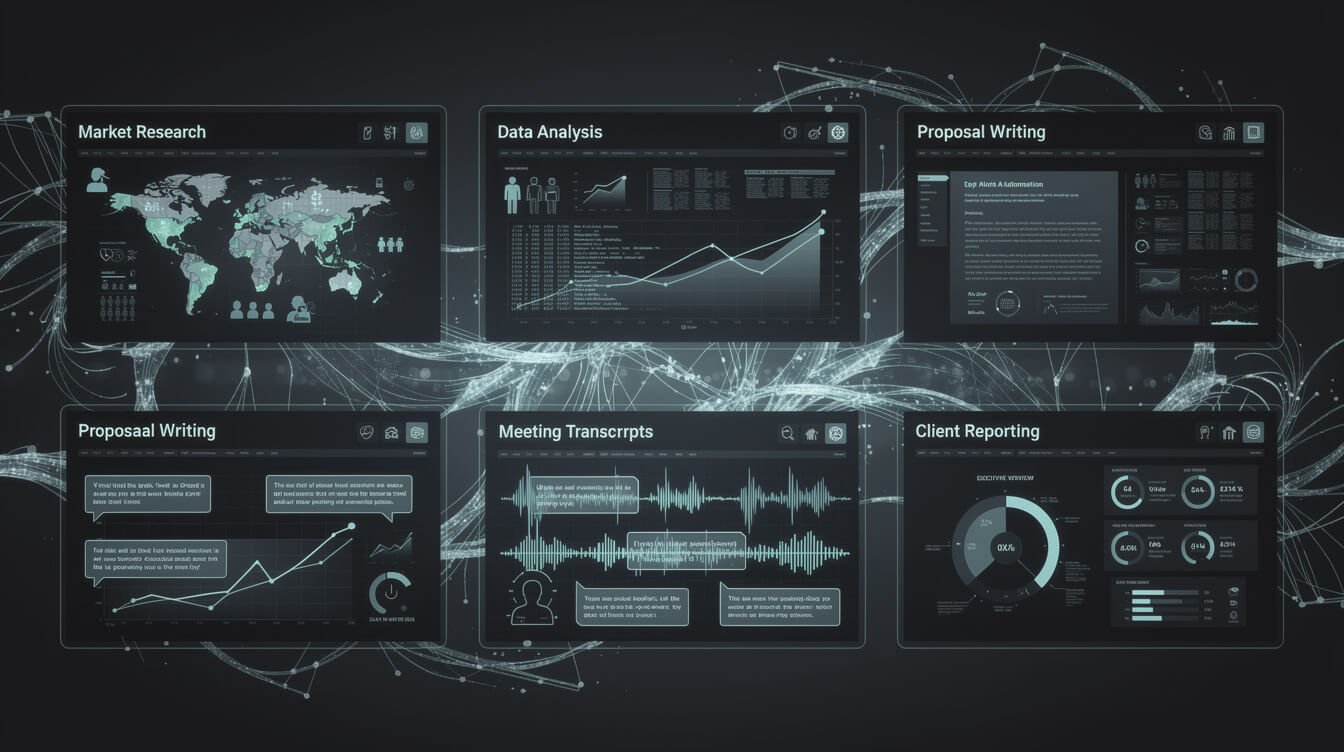
Here’s where theory becomes practice. If you’re still doing any of these five things manually in 2026, you’re leaving significant capacity on the table.
1. Industry and Competitor Research
What used to take two to three days of browser tabs and spreadsheets now takes about twenty minutes with the right AI research workflow. Feed a competitor’s website, recent press releases, job postings, and LinkedIn activity into Claude with a structured research prompt. Get back a comprehensive competitive brief that’s more thorough than anything a junior analyst would have produced — and ready to refine strategically, not rebuild from scratch.
Practical setup: Claude + Firecrawl (for web scraping) + a structured research prompt template you’ve refined over time. Twenty minutes of AI agent work, then thirty minutes of strategic synthesis on your end. That’s the human-AI divide in practice — and it’s the most compelling demonstration of how autonomous AI agents augment rather than replace expert judgment.
2. Data Analysis and Market Sizing
AI handles messy CSV exports, earnings call transcripts, and industry reports with surprising competence — turning raw data into structured analysis with sources cited. Not perfect; you still need to verify the critical numbers. But the first draft takes fifteen minutes, not three days. Useful for TAM/SAM/SOM calculations, competitive pricing analysis, and customer segment sizing across most consulting contexts.
3. Proposal and Deliverable Writing
This is where AI saves the most time for most consultants. A well-scoped client proposal used to take four to six hours. With AI, it takes forty-five minutes: thirty minutes defining scope and approach with the client, fifteen minutes refining the AI-generated draft. The key is not using AI to write from scratch — use it to expand and structure a detailed outline you’ve already approved. You provide the strategic architecture; AI handles language and formatting.
4. Meeting Prep and Follow-Up
Before every major client meeting, feed the recent email thread, project brief, and relevant research into Claude with a pre-meeting brief prompt. It surfaces key open questions, potential objections, and context you might otherwise miss. Takes three minutes. After meetings, paste the transcript or voice memo transcription into Claude, request action items, decisions made, and next steps. Five minutes total. A junior analyst used to spend two hours on the same cycle.
5. Ongoing Client Reporting
If you deliver regular client reports — weekly performance updates, monthly dashboards, quarterly business reviews — AI should be generating the first draft. Maintain a consistent template, feed in the new data each cycle, and you have an eighty percent complete report in fifteen minutes. The twenty percent requiring your judgment — interpretation, recommendations, strategic framing — is where you earn your fee. The rest is logistics.

Get the AI Playbook for Operators
Real AI automation systems, build logs, and operator playbooks — delivered weekly. No fluff, no AI hype. Just what’s actually working.
How to Build Your AI-Augmented Consulting Stack in 2026

You don’t need a $50,000 enterprise AI platform. Here’s what an effective solo AI consulting stack actually looks like — the practical setup, not the vendor pitch.
Core intelligence: Claude (Anthropic)
Use Claude for drafting, research synthesis, strategic analysis, and client communication. For consulting work, the Pro tier ($20/month) is non-negotiable — the 200K token context window lets you process long client documents, contracts, and research compilations in a single session. The Projects feature is the piece most consultants overlook: upload your client’s strategy documents, previous deliverables, and background materials as project files, and every Claude session starts with full context rather than rebuilding from scratch. I covered the practical Claude Projects setup for operators in detail recently — it’s worth implementing before your next engagement starts.
Research and web data: Firecrawl or Perplexity
Firecrawl lets you programmatically extract structured data from competitor websites, job postings, and press releases. Perplexity Pro is faster for quick research questions that don’t require custom extraction. I use both depending on the depth required: Perplexity for 80% of day-to-day research queries, Firecrawl when I need to build a repeatable research pipeline for a specific client competitive intelligence need.
Automation and orchestration: n8n

⚡ GET THE AI EDGE
Weekly AI tips that actually save you time and money. No fluff, no hype — just what works.
Once you’ve built a few manual AI workflows, start automating them. n8n (open-source, self-hosted or cloud) is the workhorse for multi-step workflows involving external APIs — CRM, email, Airtable, web scraping, reporting pipelines. If you want to see what this looks like in practice before investing setup time, check out the n8n workflows that run my mornings automatically — it’s a direct look at how these tools compound over time.
Documentation: Claude plus Notion
Client deliverables, SOWs, proposals — first-drafted in Claude, structured and stored in Notion. The combination gives you searchable, versioned documentation without the overhead of a manual knowledge management system. Over a 90-day engagement, this compounds into a powerful client intelligence asset that improves every subsequent deliverable.
Total stack cost: $150-250 per month. Effective capacity: equivalent to one to two junior analysts for research-heavy consulting work, plus the automation infrastructure to run your back-office without hiring.
Pricing Strategy — What to Charge When AI Does the Heavy Lifting

Here’s where most consultants get this wrong: they think AI-augmented work means they should charge less.
The opposite is true. You should charge more.
Here’s the logic: AI doesn’t change the value your client is buying. They’re not paying for your hours — they’re paying for the outcome. The fact that you can produce a competitive analysis faster means you can take on more clients or deliver richer work per engagement, not discount existing clients because you’re more efficient.
Don’t compete on hours — compete on outcomes.
Traditional hourly or daily-rate consulting puts you in a race against efficiency. When AI makes you ten times faster, hourly billing creates three bad options: hide the AI and bill the old number of hours (unethical and unsustainable), disclose the AI and halve your fees (leaves money on the table), or switch to project-based or outcome-based pricing (the correct path).
Package your deliverables and price them based on the value created, not the hours logged. A competitive market analysis that helps a client make a $5M strategic decision is worth $20,000 regardless of whether it took you forty hours or four hours to produce. Price to value, not to effort.
Position AI as your research infrastructure, not your shortcut.
In client conversations, frame your AI stack as your operational infrastructure. You’re not a solo consultant anymore — you’re a one-person firm with research and analysis infrastructure that rivals a team of analysts. “I run AI-powered research systems that let me deliver the depth of a team at the responsiveness of an individual” is a differentiator, not a liability. This is especially compelling for mid-market clients (50-500 employees) who can’t afford a McKinsey engagement but need the analytical rigor.
The speed premium is real and underused.
Large consulting firms take weeks to staff projects and get work started. You can move from a scoping call to first deliverable in days. For clients in time-sensitive situations — M&A due diligence, competitive emergencies, go-to-market pivots — that speed is worth a significant premium. Most solo consultants don’t charge for it because they don’t think to. Start charging for it.
The New Consulting Business Model — From Billable Hours to Productized Outcomes
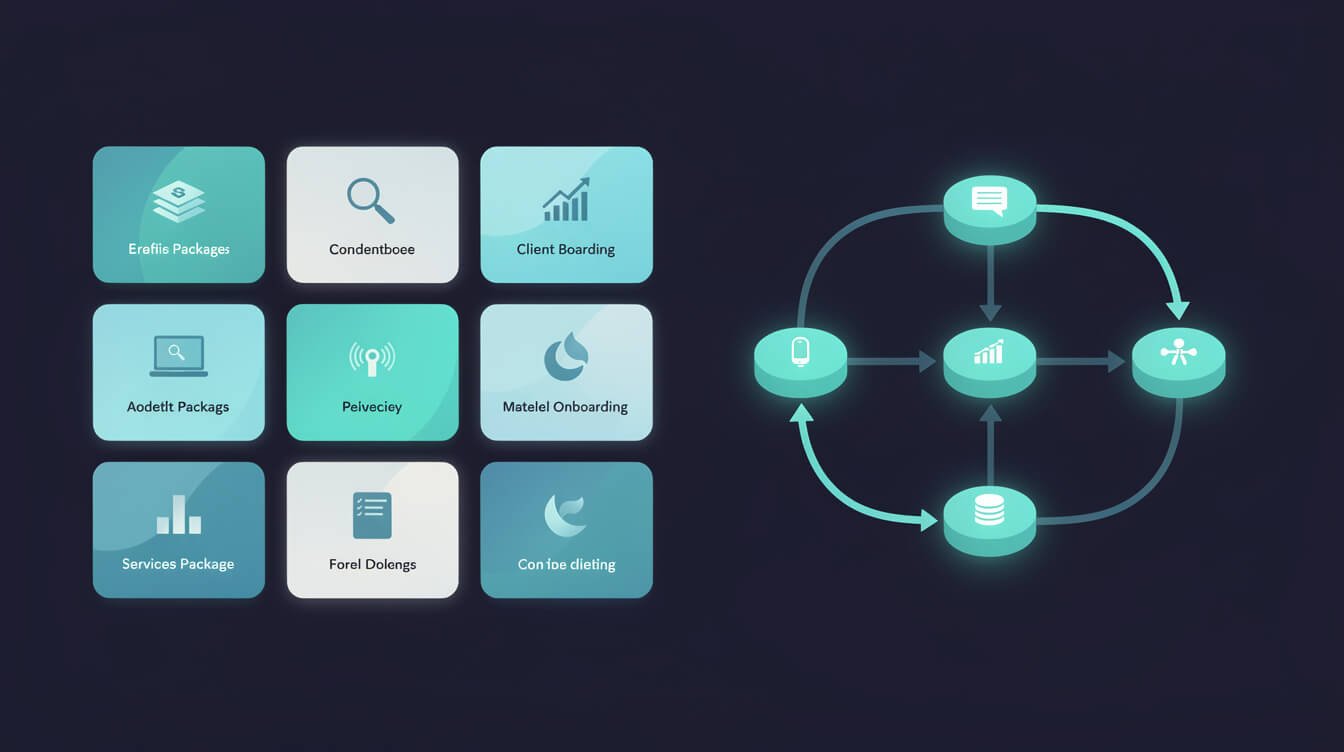
AI isn’t just changing how you do the work — it’s enabling a fundamentally different business model. The old model was bespoke, custom-scoped, hourly-billed. The new model is productized, fixed-price, outcome-defined.
Productized consulting packages are pre-packaged deliverables with clear scope, fixed price, and defined turnaround. With AI handling sixty to seventy percent of the research and first-draft writing, these become highly margin-positive engagements you can run in parallel. Three concurrent projects that used to require a team of three now require one operator and a well-tuned AI stack.
Examples that work at the intersection of AI and consulting:
- Competitive intelligence sprint: Three competitor deep-dives plus market positioning brief — $5,000, delivered in five business days
- Go-to-market audit: ICP analysis, channel assessment, 90-day prioritized roadmap — $7,500, delivered in ten business days
- AI readiness assessment: Current-state process audit, AI opportunity mapping, implementation brief — $8,000, delivered in seven business days
Async-first client communication is the other lever. Weekly async video updates (recorded Loom with AI-generated transcript and summary) instead of live check-in calls reduces your synchronous time commitment by forty to sixty percent per engagement. Clients get more responsive communication with less drain on your schedule — and most find the recorded updates more useful than live calls because they can review them at their pace.
The autonomous back-office completes the picture. Proposal generation, contract templates, invoicing, newsletter content, social media repurposing — AI can run the administrative layer that kills solo consultant profitability. The overhead that used to take two to three hours per day becomes two to three hours per week. That’s ten to fifteen additional client hours per week you can allocate to higher-leverage work or additional engagements.
If you want to see what an AI strategy consulting practice looks like as a business model — the full picture from positioning through delivery — that breakdown covers the strategic framing most guides skip.
Frequently Asked Questions: AI and Consulting

Will AI replace consultants?
Not the right consultants. AI will replace the analyst-hours spent on research, data processing, and deliverable drafting. What it won’t replace: strategic judgment developed over years of domain experience, client relationships built on trust and track record, organizational change management that requires reading people as much as data, and the credibility that comes from a history of successful implementations. The consultants at risk are those competing on research and analysis volume alone — that’s being automated. The consultants who thrive are those using AI to expand capacity and concentrate human energy on what AI can’t do.
How should I start using AI in my consulting practice?
Start with the task that takes you the most time relative to its strategic value. For most consultants, that’s research. Take one active client project and run a parallel AI research workflow alongside your usual process. Compare outputs. Refine the AI workflow until it’s producing at least seventy percent of what you’d produce manually. Then replace the manual process and move to the next bottleneck. Don’t try to automate everything at once — one workflow at a time, compounding over ninety days, produces more durable results than a wholesale tooling overhaul.
What’s the best AI tool for consultants in 2026?
Claude (Anthropic) is the strongest general-purpose tool for consulting work: extended context window, strong reasoning, and the Projects feature for maintaining client context. Perplexity Pro for real-time web research. n8n for workflow automation. This isn’t a complete picture — the right stack depends on your specific consulting work type — but this combination covers eighty percent of use cases for strategy and operations consultants.
Does AI change how consultants should price?
Yes, decisively and in the direction most consultants don’t expect: up, not down. Move from time-based to outcome-based pricing. AI makes you more productive but clients aren’t buying your time — they’re buying the result. Align your pricing with the value created. And charge explicitly for the speed premium that your AI-augmented workflow delivers versus the six-to-eight-week project timelines at a large firm.
Can I tell clients I’m using AI?
Not only can you — you should position it as a feature. The framing matters: you’re not using AI instead of expertise, you’re running AI as your research and analysis infrastructure so your human expertise is available for higher-leverage work. Clients who understand the new consulting landscape see this as a sign of operational sophistication. Clients who push back on AI use are worth having a direct conversation with about what they’re actually paying for and what the value driver is in your engagement.
Final Thoughts: The Window Is Open
AI and consulting in 2026 isn’t a threat to good consultants — it’s a leverage machine. The firms that understand this earliest will capture disproportionate value over the next two to three years before the advantage commoditizes.
For solopreneurs and indie consultants, the window is wide open right now. The SERP for “ai and consulting” is full of McKinsey and BCG think-pieces about what AI means for large firms. Nobody is talking to you — the one-person practice, the boutique shop, the specialist who wants to deliver enterprise-grade work without enterprise overhead.
That gap is your opportunity.
The AI stack is cheap, accessible, and improving every week. The technical barrier to running sophisticated AI-augmented consulting workflows is gone. What remains is the judgment to know what work is worth doing, the relationships to get in the door, and the discipline to build and use the systems. Those have always been the real competitive advantages in consulting. AI just made them more decisive.
Get the AI Playbook for Operators
Real AI automation systems, build logs, and operator playbooks — delivered weekly. No fluff, no AI hype. Just what’s actually working in production.
📥 FREE: THE AI PLAYBOOK
The exact tools and workflows I use to run a one-person agency. 25 years of marketing experience distilled into an actionable guide. Yours free.

AI & Digital Marketing Strategist
With over 25 years in digital marketing, e-commerce, sales, and international business, Jon Jones is a seasoned entrepreneur dedicated to empowering small businesses through innovative AI solutions. His journey began in investment banking on Wall Street, guiding companies through capital acquisition and complex markets, and has expanded to include expertise in web development, brand design, product development, and courses and training.
Fluent in Mandarin and with a rich foundation in both finance and tech, Jon launched JonJones.ai to provide accessible, transformative tools for small businesses to streamline operations, generate leads, and build sustainable growth. His mastery of AI, automation, and digital strategy has enabled numerous businesses to bridge the gap between traditional practices and modern technology, ensuring they thrive in today’s digital landscape.