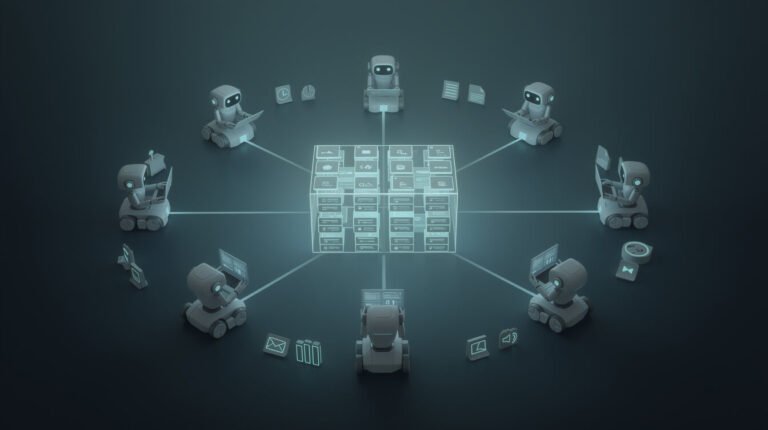

Search claude code agents and you get two kinds of results: official documentation that reads like an API reference, and explainer posts that stop at “here is what a subagent is.” Both are fine. Neither tells you what happens when you actually point these things at a real business and walk away.
I run ten brands this way. Not a demo. Not a weekend project. Ten separate businesses — each in its own container, each writing content, answering email, posting to social, and chasing leads while I sleep in a different time zone. The engine underneath all of them is Claude Code agents. This is the operator’s version of the story: what they are, how I wire them together, where they quietly break, what the whole thing costs, and whether you should build one yourself.
No hand-waving. Receipts where I have them.
What “Claude Code Agents” Actually Are (Once You Strip the Docs)

Here is the naming mess, cleared up in one breath. When people say claude code agents, they usually mean one of three different things, and conflating them is why so many beginners stall out.
- The main agent — the Claude Code session itself. You give it a task, it reads files, runs commands, edits code, and reports back. This is the thing 90% of people use and call “Claude Code.”
- Subagents — specialized helpers the main agent can spawn to handle a chunk of work in their own clean context. A “reviewer” subagent, an “explorer” subagent, a “test-writer” subagent. They keep the main thread from drowning in detail. I wrote a whole field guide on when subagents actually help and when they hurt — the short version is that they are a context-management tool, not a magic button.
- Scheduled / headless agents — a Claude Code session that runs on a cron trigger with no human watching, executes a defined job, and exits. This is the one nobody documents well, and it is the one that runs my businesses.
The docs treat these as features. The operator treats them as a hierarchy: a scheduled agent wakes up, becomes a main agent for the length of one job, and delegates pieces to subagents when the work is big enough to warrant it. Same primitives, very different framing.
The other word you will trip over is skill. A skill is a reusable instruction file — a written procedure the agent loads when a task matches. An agent is the thing doing the work; a skill is the playbook it follows. You do not choose one over the other. You write skills so your agents behave consistently every time they run, instead of improvising a slightly different process on every wake-up.
Concretely: my “blog writer” is not a smarter model than my “email agent.” It is the same Claude Code capability pointed at a different skill file. The skill is where all the brand-specific judgment lives — the voice, the publishing rules, the dedup checks, the escalation paths. Swap the skill, and the same agent does a completely different job. That separation is the single most important idea in this whole piece: agents are cheap and interchangeable; the skills you write for them are the real asset. Get that backwards — treat the model as precious and the instructions as an afterthought — and you will spend months wondering why your “autonomous” system needs constant babysitting.
The Architecture That Runs 10 Brands: Cron, Skill, Sleep

Strip away the branding and every one of my businesses runs the same three-beat loop:
- Cron fires. A scheduler inside each brand’s Docker container starts a Claude Code session at a fixed local time — blog writer at midnight, email checker at 8am, social poster at noon and again in the evening.
- Agent executes one skill. The session is handed a single job: “write and publish today’s SEO post,” or “triage the inbox,” or “repurpose yesterday’s article into five platform-native social posts.” It reads the relevant skill file, does the work end to end — research, drafting, image generation, publishing, logging — and touches the live systems (WordPress, Airtable, the mail server) through their APIs.
- Agent sleeps. When the job is done, it emits a one-line result, fires a status alert to my phone, and the container goes idle until the next cron tick.
That is the whole shape. It is deliberately boring. The magic is not in any single clever prompt — it is in the fact that the loop is identical across brands, so I can copy a working container, swap the config, and stand up a new autonomous business in an afternoon.
Two design decisions carry most of the weight. First, one agent, one job, then exit. Long-lived agents that try to do everything accumulate context rot and drift. Short-lived agents that wake, execute a tight skill, and die stay sharp and are trivial to debug — every run is a clean transcript. Second, the source of truth lives outside the agent. Queues, calendars, and logs live in Airtable and WordPress, not in the agent’s head. If a run fails, the next run picks up exactly where the data says to.
The agents also reach out to the wider tool ecosystem when they need to — MCP servers for Asana, image generation, and analytics. I break down which MCP tools earn a slot in the stack and how to install them. If you are wiring up your own fleet, my list of the MCP servers I actually run in production will save you a week of trial and error. And because the whole thing runs headless, I can babysit it from anywhere — here is how I drive the fleet from my phone when something needs a nudge.
What My Claude Code Agents Do Every Day (The Real Pipeline)

People assume “autonomous business” means one giant AI doing everything. It does not. Each brand is a fleet of small agents on a staggered schedule, and the day looks like a shift roster. Here is a real one, lightly simplified:
- 00:00 — Blog writer. Pulls the highest-priority keyword from the content queue, runs live SERP research, scrapes the top competitors, writes a 2,500–3,500 word post in the brand voice, generates its own images, sets the SEO metadata, and publishes. The post you are reading was produced by exactly this agent.
- 04:00 (weekly) — Search Console sweep. Reads Google Search Console and GA4, finds pages slipping from page one to page two, and queues them for a rewrite. The blog writer picks those up before it writes anything new — a self-healing SEO loop with no human in it.
- 08:00 — Email agent. Triages the inbox, drafts replies in the founder’s voice, and files anything financial or ambiguous as a task for me instead of guessing.
- 12:00 — Social + mining. Repurposes the day’s content into platform-native posts, and separately mines target communities for conversations worth joining.
- Evening — Video + engagement. Renders a short vertical video from the day’s article and follows up on social threads.
- 22:00 — Watchdog. Checks that every scheduled job actually ran, and pings me if one silently failed.
Notice what is not here: a human in the critical path. My job is not to approve each post — it is to design the skills, set the guardrails, and review the exceptions the agents escalate. The content is the product, but it is also the case study. Every published post is proof the pipeline works, which is the entire point of the brand.
This is also where the difference between an agent and a plain automation shows up. A no-code workflow tool like n8n is fantastic at “when X happens, do Y” — deterministic plumbing. A Claude Code agent is for the parts that need judgment: read these five competitor articles and decide what angle nobody has covered. You want both, and knowing which job goes to which tool is most of the skill.

Steal My AI Playbook
The exact patterns I use to run a fleet of autonomous businesses with Claude — workflows, prompts, and the guardrails that keep them from going off the rails. Free. No fluff.
Where Claude Code Agents Break — and How I Catch It

Anyone who tells you autonomous agents “just work” has never run them past week two. They break. The skill is not preventing every failure — it is making failures loud, contained, and cheap. Here is where mine actually go wrong, in order of how often it happens:
1. Silent no-ops
The single most dangerous failure is the agent that thinks it succeeded and did nothing. The queue was empty, an API returned an unexpected shape, and the agent cheerfully reported “done.” Fix: every skill ends with a structured result line, and a separate watchdog agent verifies that each job produced a real artifact — a live URL, a new record — not just a happy log message.

⚡ GET THE AI EDGE
Weekly AI tips that actually save you time and money. No fluff, no hype — just what works.
2. Hallucinated data
An agent left to its own devices will happily invent a statistic to make a paragraph flow. Hard rule across every brand: never invent data; if the queue is empty, skip gracefully. Facts come from a research step that actually scraped a source, or they do not go in.
3. Format drift on external APIs
WordPress converts an image to WebP; a social platform rejects it. Airtable renames a field; a filter returns nothing. These are not AI problems — they are integration problems — but the agent is the one holding the bag at 3am. Fix: pin the brittle bits (image formats, field names) in the skill file and let the agent treat them as law.
4. Over-delegation
Early on I let agents spawn subagents too eagerly and watched token costs balloon for no quality gain. The lesson mirrors what I found reviewing AI-written code — more agents is not more correct. I dug into that tension in my piece on whether Claude reviewing Claude’s code can be trusted. Spoiler: delegation earns its keep only when the sub-task is genuinely independent.
The meta-lesson: the agent is not the risky part — the seams are. Spend your engineering effort on verification and escalation, not on a cleverer prompt. If you are staring at this list thinking “that is a lot of edge cases to get right,” you are correct, and that is exactly the work I do for clients who want the outcome without eating the eighteen-month learning curve. Designing those guardrails is the job.
The Cost Reality: What a Fleet of Agents Actually Runs You

Let us talk money, because the “AI runs my business for free” crowd is lying to you. It is not free. It is cheap relative to a human doing the same work, which is a very different claim.
The costs break into three buckets:
- Model tokens. The big one. A full blog-writing run — research, drafting, revision — burns real tokens, and a fleet of agents running daily across ten brands adds up. This is the line item you actually manage. Short-lived, single-purpose agents are not just easier to debug; they are cheaper, because they do not drag a bloated context through every step.
- Per-artifact services. Image generation runs a few cents each; a short video renders for well under a dollar. Individually trivial, but multiply by daily cadence and it is a line you watch.
- Infrastructure. A VPS running the containers, plus the SaaS APIs — Airtable, an email service, a scheduling tool. Fixed and boring, which is what you want.
Here is the honest framing. The whole fleet costs a fraction of one part-time content hire, and it never sleeps, never forgets the brand voice, and never quits. But it also will not have a brilliant strategic insight in the shower. It executes a system you designed. If the system is mediocre, you now have mediocre output at scale — which is worse, not better.
That is the trap I watch people fall into: they think agents replace strategy. They replace execution. The leverage is real, but only if there is a good operator behind it. Which brings us to the question everyone actually wants answered.
Claude Code Agents: Frequently Asked Questions
Do I need to be a developer to use Claude Code agents?
To use the main agent interactively? No — you describe what you want and it does the work. To run a fleet of unattended scheduled agents like mine? You need to be comfortable with the command line, Docker, and reading API docs. Not a senior engineer, but not a no-code-only operator either. The gap is closing fast, but today it is real.
How is this different from n8n, Zapier, or Make?
Those tools are deterministic: fixed triggers, fixed steps. Claude Code agents handle the judgment-heavy work in between — reading, deciding, writing. In practice you use both, and the interesting part is drawing the line. If you are weighing platforms, I compared the landscape in my operator’s shortlist of n8n alternatives.
Can agents really run a whole business unattended?
They can run the repeatable execution of a business unattended — content, outreach, first-line support, reporting. They cannot set the strategy, close the high-ticket deal, or decide what the business should become. Mine escalate anything that smells like a real decision straight to me. That boundary is a feature, not a limitation.
What is the single biggest mistake beginners make?
Trying to build one giant agent that does everything. Small agents, one job each, on a schedule, with the source of truth outside the agent. Boring beats clever every single time in production.
Is this safe to point at my production systems?
Only with guardrails: scoped credentials, verification steps, human escalation for anything irreversible, and a watchdog that catches silent failures. Autonomy without those is not a business — it is a liability with a cron schedule.
Final Thoughts: The Operator Is the Moat
The reason I publish all of this — the architecture, the failure modes, the costs — is that the knowledge is not the moat. Anyone can read how claude code agents work. Very few people will do the unglamorous work of designing tight skills, wiring up verification, and running the thing in production long enough to trust it.
That is the whole game. The models keep getting better; the primitives keep getting easier. What compounds is operator judgment — knowing which job belongs to a deterministic workflow and which needs an agent, where to spend tokens and where to save them, what to automate and what to keep human. Build that, and you do not have an AI business. You have a business that happens to run on AI, which is a far more durable thing.
Start small. Pick one repeatable job you do every day, write it down as a skill precise enough that a stranger could follow it, and hand it to a single agent on a schedule. Watch it for a week. Fix the seams. Then do it again. That is exactly how a ten-brand fleet gets built — one boring, reliable agent at a time.
Steal My AI Playbook
The exact patterns I use to run a fleet of autonomous businesses with Claude — workflows, prompts, and the guardrails that keep them from going off the rails. Free. No fluff.
📥 FREE: THE AI PLAYBOOK
The exact tools and workflows I use to run a one-person agency. 25 years of marketing experience distilled into an actionable guide. Yours free.

AI & Digital Marketing Strategist
With over 25 years in digital marketing, e-commerce, sales, and international business, Jon Jones is a seasoned entrepreneur dedicated to empowering small businesses through innovative AI solutions. His journey began in investment banking on Wall Street, guiding companies through capital acquisition and complex markets, and has expanded to include expertise in web development, brand design, product development, and courses and training.
Fluent in Mandarin and with a rich foundation in both finance and tech, Jon launched JonJones.ai to provide accessible, transformative tools for small businesses to streamline operations, generate leads, and build sustainable growth. His mastery of AI, automation, and digital strategy has enabled numerous businesses to bridge the gap between traditional practices and modern technology, ensuring they thrive in today’s digital landscape.