
An AI SEO agency sells you visibility in a search world that no longer ends at ten blue links. That is the pitch. The problem is that every page-one result for this term is written by someone who sells it, and I scraped all of them to check. Three of those pages are ranked “best of” guides. All three rank their own publisher at number one.
I am an awkward person to write this. I run an autonomous content pipeline that is AI-assisted SEO at production scale: 318 published posts, 200 of them since June, 51 in the last thirty days, all researched, written, illustrated and published by agents on a cron schedule. I am also not selling you an AI SEO retainer. That combination means I can open the machine, show you which parts of this work are genuinely automatable and which still need a human, and hand you a test you can run on any agency before you sign.
Receipts beat adjectives. Every competitor on this page has adjectives.
What an AI SEO agency actually does that a normal SEO agency doesn’t

Strip the branding off the page-one service pages and you find the same five workstreams underneath. OuterBox publishes the clearest itemised version of them, which is why it is the most useful competitor in this SERP despite being a sales page.
- Answer-engine visibility work. Getting cited inside AI Overviews, ChatGPT, Perplexity and Gemini answers rather than just ranking below them. This is the one genuinely new deliverable.
- Entity and schema work. Making a machine able to state what your company is, what it sells and who it serves without guessing. Mostly structured data, mostly not new, now much higher stakes.
- Content production at higher volume. Models drafting, humans editing. This is where the “AI” in most AI SEO retainers actually lives.
- Prompt and query mapping. Building the list of conversational questions buyers actually type into an assistant, as opposed to the keyword list they type into a search box. Percepture productises this as a named deliverable.
- Citation and mention building. Getting your brand named on sources the models already trust, because models cite sources, not rankings.
Notice what is missing from that list: anything that replaces technical SEO, site speed, internal linking or a crawlable information architecture. Those still decide whether any of the above works. A good AI SEO agency is a normal SEO agency that has added answer-engine measurement and a production capability. A bad one is a normal SEO agency that has added a pricing tier.
The distinction matters because the deliverable you are buying changed but the failure mode did not. If you want the wider view of how this sits inside agency-land generally, I wrote the parent piece on what an AI agency actually is and a buyer’s checklist for choosing the best AI agency. This piece is the search vertical specifically.
GEO, AEO, and LLMO: which of these acronyms describe real work

You will be quoted at least two of these. Here is the honest mapping, because nobody on page one will give you one. Percepture has an entire H2 comparing all four terms and then sells all four.
- GEO (Generative Engine Optimization) — optimising to be cited inside generated answers. Real category, genuinely different measurement, terrible name.
- AEO (Answer Engine Optimization) — functionally the same thing, older term, originally about featured snippets and People Also Ask. Substantially overlapping with GEO.
- LLMO (Large Language Model Optimization) — a rebrand of the above with the model named in the acronym. I have not yet seen a deliverable under this label that was not already covered by the other two.
- AI SEO — the umbrella retail term. Usually means all of the above plus AI-assisted content production.
My read after scraping 20,000-odd words of competitor copy: there is one new discipline here and three names for it. The new part is real. Being cited in an answer is measurably different from ranking, because citation is winner-take-few rather than winner-take-one, and because the query that triggers the citation is often a full sentence you never saw in your keyword tool.
What is not real is the implication that each acronym is a separate line item. If an agency quotes you GEO and AEO and LLMO as three priced workstreams, ask which specific deliverable differs between them. A good answer exists. Most vendors do not have one ready.
Why every “best AI SEO agency” list is written by an agency on the list

This is the finding that should change how you read the entire category, and it is trivially verifiable. I scraped the three ranked buyer guides sitting on page one for this term on 27 September 2026:
- Percepture publishes “Best AI SEO Agencies in the USA for 2026.” It contains an H2 titled “What most AI SEO agency comparisons miss.” It ranks Percepture number one of ten.
- Optimist publishes “The 7 Best AI SEO Agencies Helping Clients Win AI Search in 2026.” It ranks Optimist number one of seven.
- Searchbloom publishes “Best AI SEO Companies + Services in the US 2026,” complete with a five-part scoring methodology. It ranks Searchbloom number one of ten.
Three independent ranked guides. Three different winners. Each one is the author. That is not a coincidence and it is not really a scandal either, because it is the entire commercial logic of the format: the list exists to rank the publisher, and the other nine entries are the cost of making it look like a list.
Here is the more useful way to read them. Cross-reference the three sets and only two agencies appear on all three lists: iPullRank and Siege Media. Neither is ranked first by any of them. The names that survive independent repetition are precisely the names that no publisher had an incentive to promote. That intersection is worth more than any of the three rankings individually, and you can compute it yourself in ten minutes.
I hit the identical pattern in a completely different vertical when I checked Claude Code alternatives, where every comparison list also ranked its own product first. The self-ranking list is not an AI SEO problem. It is what commercial content does whenever the author is also a vendor. Which, on this SERP, is all of them.

Get the AI Playbook
The systems I actually run in production, written up the way I would explain them to one operator. No hype, no funnel, just the build.
What AI-assisted SEO production really looks like inside my own pipeline
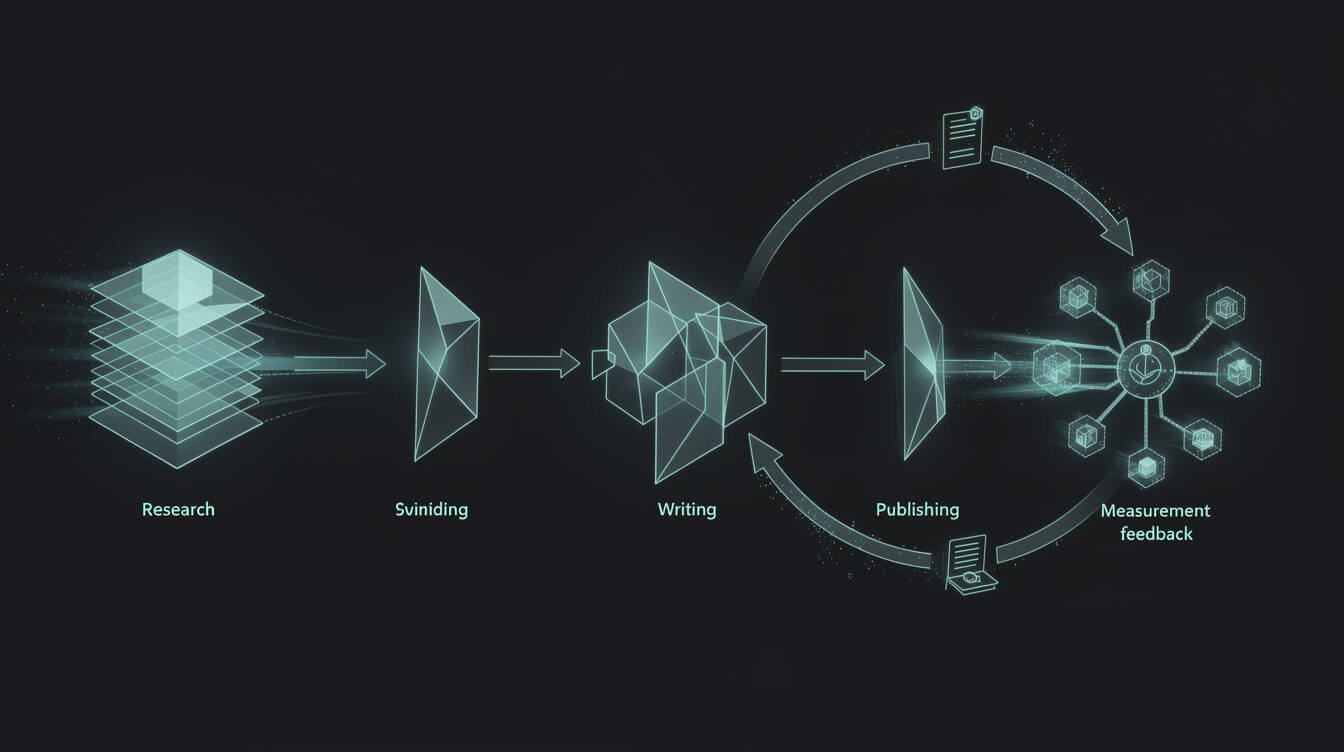
Nobody on page one shows you the inside of the machine. So here is mine, with the numbers pulled live while writing this paragraph rather than quoted from a case study deck.
I run a fleet of containerised Claude agents on a cron schedule. Each one wakes up, executes a single skill, writes a verdict line to a log, and goes back to sleep. The SEO-relevant jobs are: a keyword researcher, a content researcher that builds briefs, a daily blog writer, a social repurposer, and a weekly Search Console sweep that flags decaying pages and queues them for rewrite. This post was produced by that blog writer, which selected the keyword from a queue, re-scraped the live SERP because the brief was thirteen days old, and found the two new page-one entrants the brief did not know about.
The fleet’s actual numbers, counted at the source: 1,434 run logs. 1,318 of them carry a verdict line: 1,081 success, 195 graceful skip, 40 hard fail, 2 degraded. That is a 3.0% hard failure rate over roughly three and a half months.
Now the part an agency would never volunteer. All 40 failures live in exactly 2 of the 20 recurring job types, and 39 of the 40 are a single vendor’s expired OAuth token rejecting the same social scheduling call over and over. The fortieth is an image compression quota. Zero of them are the model writing something wrong. The risk in an automated SEO pipeline is not that the AI hallucinates your content strategy. It is that a token silently expires on a Tuesday and nothing tells you for nine days.
And the number that actually matters: 116 of those 1,434 logs contain no verdict line at all. Those runs finished without reporting what they did. That is the honest observability gap in my own system, it is the thing I would interrogate hardest if I were buying this service, and it is the exact figure no vendor page on this SERP discloses an equivalent of.
So which parts are genuinely automatable? Research, drafting, illustration, publishing, metadata, internal linking and tracking: yes, reliably, at a cost of cents per post. Deciding what is worth writing, catching a factual claim that is confidently wrong, and noticing that a whole workstream has been quietly dead for a week: no. Those are still human, and any agency telling you otherwise is selling you their own unmonitored cron job. If you want the full stack I actually run, it is itemised in the AI tools for business post.
The 6 questions that test an AI SEO agency before you sign

None of the five pages I scraped gives a buyer a way to falsify a vendor’s claims in advance. That is the real gap in this SERP, not pricing. So here is the test. Every one of these is answerable in a single call, and the quality of the answer is the signal, not the answer itself.
1. “Show me the query-level Search Console export for a client in my vertical.”
Not a traffic chart. Not a percentage. The query-level export, with impressions and average position per query. A percentage uplift with no baseline is unfalsifiable, which is exactly why Level’s page leads with 700%, +1B, +65%, 50% and 30% as bare headings with no client, no timeframe and no methodology attached anywhere on 3,821 words. An agency doing real work has this export open in another tab.

⚡ GET THE AI EDGE
Weekly AI tips that actually save you time and money. No fluff, no hype — just what works.
2. “Which parts of the deliverable are model output, and who edits them?”
There is no wrong answer here, only an evasive one. “All human” from an AI SEO agency is a lie or an overcharge. “All AI” is a content farm. What you want is a specific split: model drafts, named human edits, named human owns the factual claims. If they will not tell you where the human is, there isn’t one.
3. “How do you measure an answer-engine citation, and how often?”
This separates the category from the rebrand. Citation tracking requires deliberately prompting the assistants on a schedule and logging who got named. Ask what they prompt, how many prompts, how often, and whether you get the raw log. Vague answers mean they are selling GEO and measuring rankings.
4. “What happens to this content if I leave in six months?”
Ask who owns the briefs, the prompts, the schema and the publishing access. A great deal of AI SEO value is embedded in the production system rather than the articles. If leaving means losing the system that makes the articles, you are renting, and the renewal conversation will reflect that.
5. “Show me a page you published that did not work, and what you did next.”
Every real pipeline has losers. Mine has plenty, which is why the weekly sweep exists to find them and queue rewrites. An agency that cannot produce a single underperforming page either has not been doing this long or is not measuring. Both are disqualifying.
6. “Who else is on your best-of list, and were you paid by any of them?”
If you found the agency through a ranked list, ask whose list it was. You now know the base rate: on this SERP, three out of three ranked guides put their own publisher first. That is a fair question, and a confident vendor enjoys answering it.
Run those six on any shortlist and the field thins fast. If it would help to pressure-test a shortlist against a system that already does this work in production, book a working session and bring the proposals.
What an AI SEO agency costs: retainer, project, or building it in-house

Two of the five pages I scraped publish real numbers, which is more price transparency than this category usually gets. Everything below is quoted from the vendors’ own pages, not from me.
Percepture publishes a full rate card: AI Search and GEO growth package from $6,000 per month, project initiation and setup $2,900 one-time, AI link and mention building +$1,200 per month, digital PR activation from $4,500 per month, and white-glove prospecting at $1,990 per month plus $1 per lead. Searchbloom cites market bands of roughly $5,000 to $15,000 per month for this work. Optimist cites $2,500 to $12,000 per month. Level publishes no pricing at all across its entire page.
So a realistic mid-market retainer for full-service AI SEO in 2026 sits somewhere between $2,500 and $15,000 a month, with the genuinely specialised GEO and digital PR work clustering at the top of that range. Add-ons stack: on Percepture’s own card, a package plus links plus PR is $11,700 a month before the setup fee.
Three shapes are available to you, and the right one depends less on budget than on whether you have someone to own the work:
- Retainer. Right when you need continuous production and have nobody internal to run it. You are buying capacity and accountability. Watch the twelve-month total, not the monthly number.
- Project. Right for a technical and entity foundation, a schema rebuild, or a one-off visibility audit. Bounded scope, bounded price, and you keep the artefact. This is the most underused option in the category.
- In-house with agents. Right when you have one technical person who will own it. The marginal cost per published piece drops to cents, but the fixed cost is that person’s attention, permanently. My pipeline costs roughly a dollar a day in API calls and considerably more than that in the hours I spend reading logs.
The honest arithmetic: at $6,000 a month you are paying $72,000 a year. If one capable person could own an agent pipeline at 20% of their time, the build almost always wins on cost and almost always loses on speed-to-first-result. I went through the same trade-off in detail for AI consulting services and for the automation agency model, and the conclusion is the same here: the retainer buys you time, not capability.
AI SEO agency FAQs
Is an AI SEO agency different from a normal SEO agency?
Meaningfully, yes, but less than the pricing suggests. The new deliverable is answer-engine visibility: getting cited inside AI Overviews and assistant answers, which requires different measurement from rank tracking. Everything else on a typical AI SEO scope of work is conventional SEO plus higher-volume content production. Technical SEO, crawlability and internal linking still decide whether any of it lands.
Does AI SEO replace traditional SEO?
No, and the vendors agree on this one. Assistants overwhelmingly cite pages that already rank, so organic position remains the input to citation rather than a competing channel. Anyone selling AI SEO as a replacement for technical and content fundamentals is selling you a layer with nothing underneath it.
How long before an AI SEO agency shows results?
Expect the same curve as conventional SEO: three to six months for a foundation to show movement, longer in competitive verticals. Citation visibility can move faster than rankings on low-competition queries because the pool of cited sources is smaller, but it is also far more volatile week to week. Ask for the measurement cadence before you accept any timeline.
Can I just use AI tools myself instead of hiring an agency?
For production, yes, and cheaply. I publish a researched, illustrated, internally linked, SEO-tagged post every day from a container for roughly a dollar a day in API spend. What you cannot buy off the shelf is judgement about what to publish, an editor who catches a confident falsehood, and the discipline to notice when part of the system has silently stopped. That is the real job, and it does not automate.
What is a fair price for an AI SEO agency in 2026?
Based on the rate cards published by the agencies ranking for this term, roughly $2,500 to $15,000 per month for full service, with specialised GEO and digital PR work at the upper end and one-time setup fees around $2,900. A bounded audit or schema project is usually the better first purchase. I do not publish a rate for my own work here because scope decides it, which is exactly the answer you should be suspicious of from anyone, including me.
How do I check whether an agency’s case studies are real?
Ask for the query-level Search Console export rather than a dashboard screenshot, and check whether the claimed uplift has a baseline, a date range and a named client. A percentage with none of those three is decoration. If you want the broader version of this test applied to any AI vendor, the AI marketing agency breakdown covers the same due diligence outside the search vertical.
When to hire an AI SEO agency, and when to automate it yourself
Hire one if search is a primary acquisition channel, you have no in-house technical SEO ownership, and you need results inside two quarters. Hire one specifically for entity, schema and digital PR work, which is the hardest part to replicate solo because it depends on relationships rather than tooling. And hire one if the alternative is that nothing happens at all, which is the real alternative more often than anyone admits.
Build it if you already have one technically confident operator, if your content is genuinely expertise-led so the bottleneck is production rather than knowledge, and if you can tolerate a slow first ninety days. The pipeline that produced this post took about three weeks to get right and has published 200 posts since June. It is also down a workstream right now because of an expired token, which is the part of the pitch I would rather you heard from me than discovered yourself.
Do both, in sequence, if you can: a bounded project to fix the foundation, then internal production on top of it. That sequence gets you the agency’s leverage where it is genuinely scarce and keeps the compounding asset in-house.
Whatever you choose, run the six questions first. The category is new enough that the vocabulary is still doing most of the selling, and the SERP you are reading this on is currently three self-ranked lists and two sales pages. That is not a market with a consensus. It is a market with a vacuum, and a vacuum is exactly where a buyer who asks for the Search Console export gets a disproportionately good deal. If you want a second pair of eyes on a shortlist, grab a slot and bring the proposals.
Steal the pipeline
Join the list and get the AI Playbook: the agent stack, the prompts, and the failure modes nobody puts on a sales page.
📥 FREE: THE AI PLAYBOOK
The exact tools and workflows I use to run a one-person agency. 25 years of marketing experience distilled into an actionable guide. Yours free.

AI & Digital Marketing Strategist
With over 25 years in digital marketing, e-commerce, sales, and international business, Jon Jones is a seasoned entrepreneur dedicated to empowering small businesses through innovative AI solutions. His journey began in investment banking on Wall Street, guiding companies through capital acquisition and complex markets, and has expanded to include expertise in web development, brand design, product development, and courses and training.
Fluent in Mandarin and with a rich foundation in both finance and tech, Jon launched JonJones.ai to provide accessible, transformative tools for small businesses to streamline operations, generate leads, and build sustainable growth. His mastery of AI, automation, and digital strategy has enabled numerous businesses to bridge the gap between traditional practices and modern technology, ensuring they thrive in today’s digital landscape.