
What is an AI agency? The short version: it’s a company that gets paid to design, build, and run artificial-intelligence systems for other businesses — chatbots, automations, AI agents, whole autonomous workflows — so the client gets the outcome without hiring an in-house AI team. That’s the textbook answer, and it’s on a hundred other pages. It’s also not the answer you actually came for.
Because the real question underneath “what is an AI agency” in 2026 isn’t what does the phrase mean. It’s is this still a real business, or is it a hype cycle wearing a suit? Half the top search results define the model in glowing, vendor-neutral prose and never mention that a large slice of these agencies are thin wrappers that will not survive the year. I run one of these operations — a fleet of autonomous brands built on Claude agents — so this is the honest version: what an AI agency is, the versions that last, and the versions that don’t.
Here’s exactly what we’ll cover, no filler:
- What an AI agency actually is, in plain English
- The four AI agency models — and which are already commoditizing
- What one delivers day-to-day, with a real example from my own fleet
- How they price it: retainer vs. build vs. outcome
- The honest downsides nobody puts on their sales page
- How to tell a durable agency from a disposable reseller
- Whether you actually need one, or should just build in-house
What an AI Agency Actually Is (Plain-English, 2026 Version)

Strip away the jargon and an AI agency is a service business that sells one thing: leverage. A client has a problem — leads slipping through the cracks, a support inbox on fire, content that never ships, a sales process held together by copy-paste — and instead of hiring three people and buying five tools, they pay an agency to stand up an AI system that handles it. The agency owns the messy part: choosing the models, wiring the integrations, writing the prompts and guardrails, and making sure the thing keeps working at 3 a.m. when nobody’s watching.
What makes it an AI agency rather than a plain automation or marketing shop is where the intelligence lives. A traditional automation agency wires up deterministic “if this, then that” flows. An AI agency builds systems that reason — agents that read an email and decide how to reply, classify a lead and route it, draft a post and check it against brand rules. The line is blurring fast (most good shops now do both), but that’s the distinction that matters.
The honest 2026 framing: an AI agency is a translation layer between fast-moving AI capability and a business that doesn’t have time to track it. The models change monthly. Most owners can’t keep up, shouldn’t have to, and just want the result. That gap is the entire reason the category exists — and, as we’ll see, the reason some agencies are worth a fortune while others are worth nothing.
The Four AI Agency Models — And Which Ones Are Already Commoditizing

“AI agency” is an umbrella over at least four distinct businesses. They look similar from the outside and behave nothing alike underneath. Here’s how I’d sort them — and which ones are quietly turning into a commodity.
1. The AI Automation Agency (AAA)
The classic. Builds workflows that connect a client’s tools and let AI handle the decisions in the middle — lead routing, inbox triage, content pipelines, reporting. High demand, and the model everyone on YouTube is selling a course on. That popularity is also the problem: the barrier to entry is a weekend of tutorials, which means the low end is commoditizing hard. A generic “we’ll automate your business” pitch is already a race to the bottom.
2. The AI Marketing Agency
Focused on the go-to-market side — AI-written content, ad creative, SEO, outbound sequences, an AI marketing agent that runs campaigns on autopilot. Durable when it’s tied to real revenue outcomes; commoditizing fast wherever it’s just “we’ll use ChatGPT to write your posts.” The tools are free now. The judgment isn’t.
3. The AI Software / Agent Development Agency
Builds custom agents and applications — bespoke Claude agents, internal copilots, product features. Higher technical bar, harder to fake, and the most defensible of the four because the work genuinely requires engineering. Least commoditized, hardest to start.
4. The Vertical AI Agency
Picks one industry — real estate, dental, law, e-commerce — and goes deep. The moat isn’t the tech; it’s knowing the vertical’s workflows, compliance, and vocabulary cold. This is where a lot of the durable money is hiding in 2026, precisely because domain expertise doesn’t commoditize on the same curve the tooling does.
Pattern worth internalizing: the more the value lives in generic AI tooling, the faster it commoditizes. The more it lives in judgment, engineering, or domain depth, the longer it lasts. Hold onto that — it’s the thread through the rest of this piece.
What an AI Agency Really Delivers Day-to-Day (With a Real Example)

Sales pages love the word “solutions.” Useless. Here’s what an AI agency actually hands over, in concrete terms:
- Working systems — an agent or automation that runs on a schedule or a trigger and produces real output (a reply sent, a lead scored, a post published)
- Integrations — the plumbing between the client’s CRM, inbox, site, and data so the AI can actually see and act
- Guardrails — the boring, critical part: rules, review steps, and fallbacks so the system fails safely instead of embarrassingly
- Monitoring and maintenance — because a model update or an API change will break something, and someone has to catch it
Here’s a real one from my own operation instead of a hypothetical. I run a fleet of autonomous brand containers — each one a small business that publishes content, posts to social, answers email, and chases leads without me touching it daily. This very article was written and published by an agent on a cron schedule, pulling a keyword from a queue, researching the SERP, generating its own images, and pushing everything live through the WordPress API. That’s the deliverable an AI agency is really selling: not a “solution,” but a system that keeps working after the invoice clears. If you want to see the guts of how that fleet is wired, I broke it down in what actually runs my 10-brand fleet of Claude Code agents.
The uncomfortable truth for buyers: a lot of agencies deliver the demo, not the system. It looks incredible in the sales call and quietly rots two weeks after handoff. The difference between those two outcomes is the whole game, and we’ll get to how you spot it.

Steal my AI Playbook
Want the exact playbook I use to run autonomous businesses on AI agents? Grab the free AI Playbook and I’ll send the systems, not the hype.
How an AI Agency Prices It: Retainer vs. Build vs. Outcome
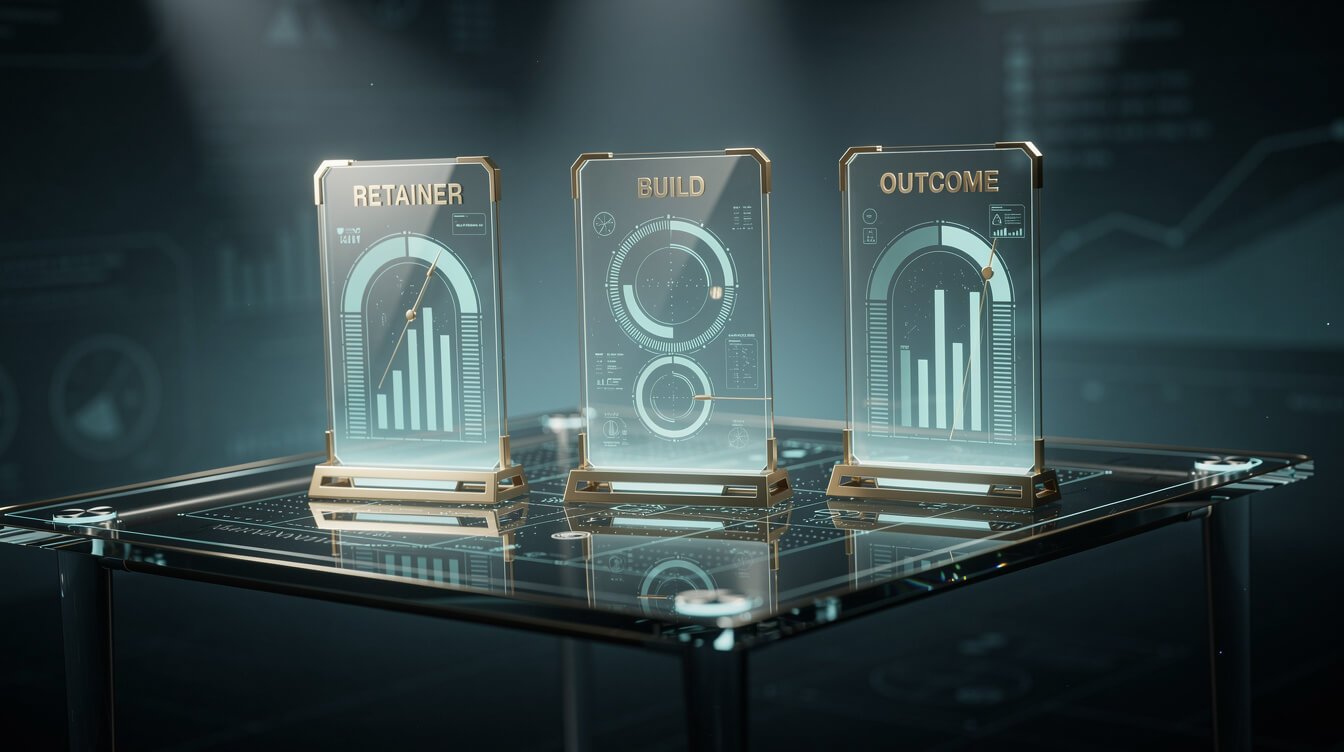
Pricing tells you more about an agency than its portfolio does. There are three real structures, and each one quietly signals how the agency thinks about your success.
Monthly retainer
You pay a recurring fee — often $2k–$10k+/month — for ongoing builds, tweaks, and management. Great when the work is genuinely continuous. Dangerous when the “management” is really just billing you every month to keep systems alive that should have been handed over. Ask what happens to the retainer once everything is built.
Project / build fee
A fixed price for a defined build — “$8k to stand up your AI support agent, delivered and documented.” Cleaner incentives, clearer scope, and you’re not renting your own system forever. My bias is heavily toward this model: build it, harden it, hand you the keys, and let you own it outright. That’s the done-for-you build philosophy — you get the asset, not a dependency.
Outcome / performance
The agency ties its fee to a result — leads booked, revenue lifted, hours saved. Beautiful in theory, rare in practice, because attribution is hard and most agencies won’t take the risk. When you find one that will, it usually means they’re confident the system actually works.
The tell isn’t the number — it’s the incentive. A retainer that never ends rewards the agency for keeping you dependent. A build-and-hand-off rewards them for making you self-sufficient. Decide which relationship you actually want before you read a single proposal.
The Honest Downsides Nobody Lists

Every “what is an AI agency” article stops at the benefits. Here’s the part they skip — the stuff you’d want a friend in the industry to tell you.

⚡ GET THE AI EDGE
Weekly AI tips that actually save you time and money. No fluff, no hype — just what works.
Wrapper risk. A large share of AI agencies are thin layers over someone else’s model with a nice dashboard bolted on. There’s nothing durable underneath — no proprietary judgment, no engineering, no domain moat. The day the underlying tool ships the same feature natively (and it will), that agency’s value evaporates. If you can’t tell what the agency knows that the base model doesn’t, that’s the wrapper you’re paying for.
Over-promising. “Fully autonomous, set-and-forget, replaces your whole team.” No. Good AI systems reduce human load massively, but the ones that last have humans in the loop at the right checkpoints. Anyone selling zero-oversight magic is selling the demo, not the system.
Churn and fragility. AI systems break. Models get deprecated, APIs change, an update shifts behavior overnight. If the agency built something clever but brittle and then walked away, you inherit a black box that fails at the worst possible moment. Maintenance isn’t an upsell — it’s the actual job.
The commoditization clock. As covered above, the generic end of this market is racing to the bottom. If you hire on price alone, you’re very likely buying the exact service that’ll be free-with-a-checkbox inside a year.
None of this means the model is broken. It means you have to buy carefully — which brings us to the single most useful filter I can give you.
Want the agent, not the agency retainer?
I build the autonomous systems, hand you the keys, and you own them outright. If you want a straight answer on whether that fits your business, let’s talk.
Durable vs. Disposable: What Separates a Real AI Agency From a Reseller

Here’s the filter. A durable AI agency owns at least one thing the base model can’t hand your competitor for free:
- Engineering depth — they build real systems, not just prompts in a no-code box. They can show you architecture, not just screenshots.
- Domain expertise — they know your industry’s workflows and edge cases so well that the AI is configured for your reality, not a generic template.
- Operational track record — they run this stuff themselves, at scale, and can show receipts. An agency that operates its own autonomous systems has skin in the game a reseller never will.
- Ownership handoff — they build to make you independent, not dependent. The system is yours, documented, and it survives without them.
A disposable agency has none of that. It’s a landing page, a Zapier account, and a course-taught pitch. It’ll sell you the same “solution” it sells everyone, it can’t explain what breaks or why, and it evaporates the moment the tooling catches up.
One clean test before you sign: ask them to show you something they run for themselves. Not a client case study — their own operation. Anyone genuinely durable is already using this technology to run their own business and will happily walk you through it. If the only AI systems they can point to are the ones they’d build for you, be careful. Receipts beat promises every single time.
Do You Need an AI Agency, or Should You Build In-House?
Sometimes the honest answer is “you don’t need us.” So here’s the straight version.
Build in-house when: you have (or want) technical capability on the team, the problem is core to your business, and you’re willing to climb the learning curve. The tools are more accessible than ever — you genuinely can start small yourself. And no, you don’t need to be an engineer to begin; I made that case in this myth-buster on running AI agents without a technical background.
Hire an agency when: speed matters more than learning, the stakes are high enough that you want it done right the first time, or you simply don’t want AI systems to become your job. Buying expertise to skip six months of trial-and-error is a completely rational trade.
The hybrid — my favorite for most SMBs — is to hire someone to build and hand off, then run it in-house. You get the expert architecture without the forever-retainer. That’s the whole reason I lean toward done-for-you builds over managed dependency: I’d rather you own the machine than rent it from me. If you’re weighing the full operator model, I laid out how I run an agency where the agents do the delivery in this build-log on building an AI agency.
Frequently Asked Questions About AI Agencies
What is an AI agency in simple terms?
An AI agency is a company you pay to design, build, and run artificial-intelligence systems — chatbots, automations, and AI agents — so your business gets the results of AI without hiring an in-house AI team. Think of it as an outsourced AI department that hands you working systems instead of advice.
What is the difference between an AI agency and an AI automation agency (AAA)?
An AI automation agency is one type of AI agency — the one focused on connecting your tools and letting AI handle the decisions in between (lead routing, inbox triage, content pipelines). “AI agency” is the broader umbrella that also covers marketing, custom software/agent development, and vertical-specific shops.
How much does an AI agency cost?
It depends on the model. Monthly retainers commonly run $2k–$10k+ per month; fixed-price builds range from a few thousand dollars for a single automation to five figures for a full custom agent system. Outcome-based pricing (tied to leads or revenue) exists but is rarer. Cheaper isn’t safer — the low end is exactly where commoditized wrapper agencies live.
Is starting an AI agency still worth it in 2026?
Yes, but only if you build something durable. The generic “we’ll automate your business” end of the market is commoditizing fast. The agencies that last own real engineering depth, deep domain expertise, or an operational track record they can prove — not a thin wrapper over someone else’s model.
Do I need technical skills to work with or start an AI agency?
To hire one, no — that’s the point of paying for done-for-you delivery. To start one, you don’t need to be an engineer either, but you do need real judgment and ideally hands-on experience running these systems yourself. Buyers should always ask an agency to show something they operate for their own business.
The Honest Answer
So — what is an AI agency? It’s a business that sells leverage: the ability to put working AI systems inside your company without building the expertise from scratch. The model is real, the demand is real, and it’s not going anywhere. But the market is splitting in two. On one side, durable agencies with engineering, domain depth, and real operational receipts. On the other, disposable wrappers racing the commoditization clock to zero.
Your job as a buyer is simple, even if it isn’t easy: figure out which side of that line anyone you’re considering sits on. Ask what they run for themselves. Ask what happens after the build. Ask why the base model can’t just do this for free next quarter. The good ones will have crisp answers. The disposable ones will change the subject.
That’s the honest 2026 definition — from someone who actually runs one.
Get the systems, not the hype
Every week I share the exact autonomous-AI systems I run across my fleet — real builds, real receipts. Grab the free AI Playbook and start with mine.
📥 FREE: THE AI PLAYBOOK
The exact tools and workflows I use to run a one-person agency. 25 years of marketing experience distilled into an actionable guide. Yours free.

AI & Digital Marketing Strategist
With over 25 years in digital marketing, e-commerce, sales, and international business, Jon Jones is a seasoned entrepreneur dedicated to empowering small businesses through innovative AI solutions. His journey began in investment banking on Wall Street, guiding companies through capital acquisition and complex markets, and has expanded to include expertise in web development, brand design, product development, and courses and training.
Fluent in Mandarin and with a rich foundation in both finance and tech, Jon launched JonJones.ai to provide accessible, transformative tools for small businesses to streamline operations, generate leads, and build sustainable growth. His mastery of AI, automation, and digital strategy has enabled numerous businesses to bridge the gap between traditional practices and modern technology, ensuring they thrive in today’s digital landscape.