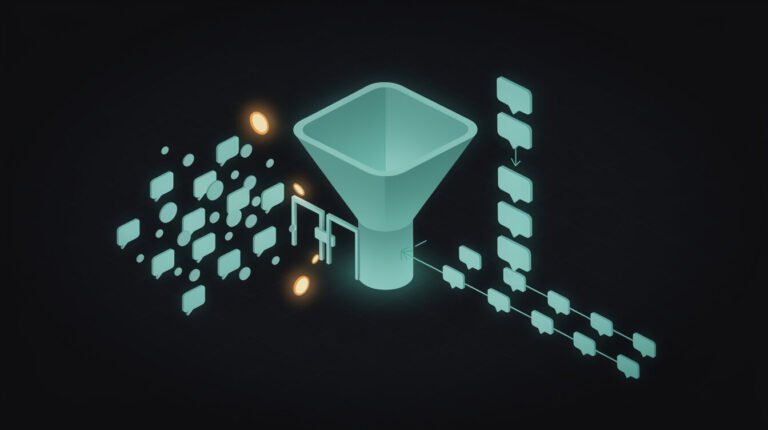

Every Friday I answer one question I actually get asked. This week’s comes from small business owners who have just watched someone demo a “team” of 30 agents: how many AI agents does my business actually need?
I’m a useful person to ask because I overdid it. This brand runs 20 scheduled agents. Since mid-June they’ve logged 1,674 runs. So this morning I sorted all 20 by one question: when this agent finishes, who or what uses the result?
The short answer: one agent per consumer, not one per task
Here’s how my 20 sort out:
| Where the output goes | Agents | Examples |
|---|---|---|
| Straight to the public | 6 | Blog posts, social posts, the newsletter, outreach emails |
| Into another agent’s queue | 8 | Keyword research, content briefs, lead lists |
| To me, as a report | 4 | The nightly watchdog, inbox triage, search console sweep |
| To a human who never showed up | 2 | Reddit reply drafts and the follow-ups to them |
The first three rows work. Each one has a consumer that shows up every day: Google, a subscriber list, a downstream agent, or me reading a nightly summary.
The last row is the lesson. Those two agents were built to find Reddit threads, draft helpful replies, and then track the conversations. Posting was left to a person, copy-paste style. That person never existed. Between them they’ve run 253 times, written 439 drafts, and 0 have been posted. The follow-up agent has watched an empty conversation log every afternoon for four months. Every run finished green.
Why “how many AI agents” is the wrong first question
Agent count is the number people brag about, because it’s easy to count. But an agent that does real work and hands it to nobody costs you money, API calls and attention, and nothing comes out the other end.

⚡ GET THE AI EDGE
Weekly AI tips that actually save you time and money. No fluff, no hype — just what works.
So the real question is: how many places in your business can take work in on a schedule, without you? That’s your ceiling. For most small businesses it’s 2 or 3 to start. Maybe your website, your email list, and your own inbox.
Feeder agents are fine too. Eight of mine exist only to feed other agents, and they’re some of the most useful ones I run. A feeder earns its slot when the agent it feeds actually runs and uses what it’s given. My keyword agent works because the blog agent eats from its queue every night. My Reddit agent failed because the next link in its chain was a human with a different job.
I wrote about the same 0-posted pile when I asked whether an agent is just a cheaper VA, and again in the readiness check. Today’s angle is sizing. Don’t plan the fleet around the jobs you’d like done. Plan it around what can actually receive the work.
How to size your first AI agent setup
- List your consumers first. Write down every place work could land without you: your site, your list, your CRM, a social scheduler, your own morning summary. That list is your maximum agent count for now.
- Start with one agent per consumer that pays. If a blog post brings in leads, a blog agent is your first hire. Everything else waits.
- Add a feeder only when its consumer is hungry. Research agents come after the writing agent has run for a few weeks and you can see it running short on material.
- Put a human in the chain on purpose, or not at all. If a step needs you, give it a name, a time slot and a weekly count. “Someone will copy-paste these” isn’t a plan.
- Check output, not run status. Once a month, ask of every agent: what left the building because of it? If the answer is “nothing,” pause it. Don’t fix it yet.
If you’re still at zero agents, what to automate first is the place to start. And if you’re comparing a first agent with hiring help, read what actually transfers in that swap.
Want help mapping your consumers before you build anything? Book a strategy session and we’ll find the two or three agents worth running first.
See you next Friday. — Jon
📥 FREE: THE AI PLAYBOOK
The exact tools and workflows I use to run a one-person agency. 25 years of marketing experience distilled into an actionable guide. Yours free.

AI & Digital Marketing Strategist
With over 25 years in digital marketing, e-commerce, sales, and international business, Jon Jones is a seasoned entrepreneur dedicated to empowering small businesses through innovative AI solutions. His journey began in investment banking on Wall Street, guiding companies through capital acquisition and complex markets, and has expanded to include expertise in web development, brand design, product development, and courses and training.
Fluent in Mandarin and with a rich foundation in both finance and tech, Jon launched JonJones.ai to provide accessible, transformative tools for small businesses to streamline operations, generate leads, and build sustainable growth. His mastery of AI, automation, and digital strategy has enabled numerous businesses to bridge the gap between traditional practices and modern technology, ensuring they thrive in today’s digital landscape.