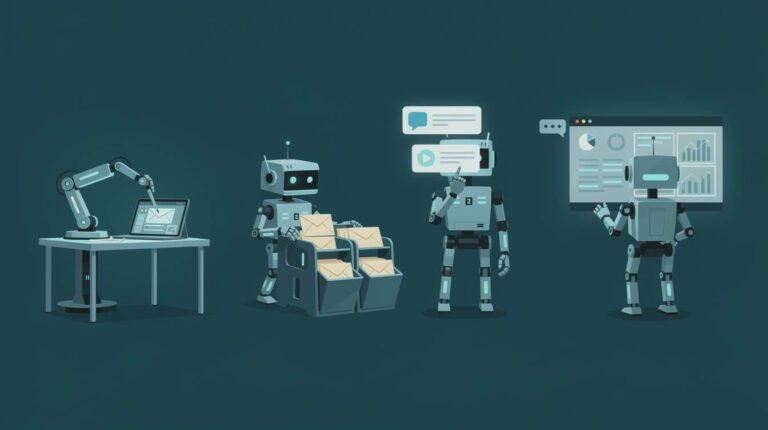
If you searched for the best AI agent for small business, you were probably hoping for a single name — one tool to buy, plug in, and forget. I have bad news and good news. The bad news: that single perfect agent doesn’t exist. The good news: once you stop looking for it, the whole decision gets easy, cheap, and fast.
I run ten autonomous businesses with a team of one — me — plus a fleet of AI agents that write, publish, email, and report while I sleep. So I don’t review these tools from a spec sheet. I run them in production, watch them fail, fix them, and pay the bills. This guide is the honest version: which agent actually earns its keep for which job, what to ignore, and how to pick without wasting a month of your life on a pilot that goes nowhere.

There Is No Single “Best AI Agent for Small Business” — and That’s Good News

Every listicle wants to crown one winner because “The 1 Best AI Agent” gets clicks. But an AI agent is not a phone. It’s a worker. And you’d never ask “what’s the best employee?” without asking for what job? A bookkeeper and a salesperson are both great hires — for completely different reasons.
AI agents work the same way. The best agent for answering your support inbox is a terrible choice for chasing unpaid invoices. So the real question isn’t “what’s the best AI agent for small business” in the abstract — it’s “what’s the best agent for this specific job in my business, given my budget and how technical I am.” Answer that, and the shortlist writes itself.
This reframe is the single most valuable thing in this article. Hold onto it. Everything below is organized around jobs, not around whichever vendor paid for the top spot on someone else’s blog. If you want the deeper backstory on what an agent even is, my complete guide to autonomous AI agents covers the mechanics; here we’re strictly about picking one.
The Honest Filter: What Actually Makes an Agent Worth It

Before I recommend anything, here’s the filter I run every tool through. Most “AI agents” fail at least one of these, and any single failure is enough to walk away.
- Does it take real action, or just chat? A chatbot answers. An agent does — sends the email, books the slot, updates the record. If it can’t touch your actual tools, it’s a demo, not a teammate.
- Does it connect to what you already use? Your agent is only as useful as its reach into your inbox, calendar, CRM, and spreadsheets. “Connects with some API work” means that work lands on you.
- Can a non-developer keep it running? If it needs a Python engineer every time something breaks, and you don’t have one, it will sit half-configured forever.
- Does it fail safely? The best agents ask before doing anything irreversible and log everything they touch. An agent that quietly emails your whole list is a liability, not an asset.
- Is the pricing honest at your scale? Per-seat, per-action, and per-workflow pricing hit tiny businesses very differently. Cheap-per-user can be brutal at volume, and vice versa.
Notice what’s not on that list: “how advanced is the AI.” At this point the underlying models are all good enough. What separates a keeper from a time-sink is plumbing, safety, and price — not raw intelligence.
The Best AI Agent for Small Business, by Job

Here are my honest picks, grouped by the job you’re actually trying to get done. For each one I’ll name what I’d reach for, who it fits, and the catch — because every tool has one.
One rule before the list: pick one job to start. The mistake I see most often is a business owner who reads a roundup, gets excited, and tries to deploy five agents in a weekend. All five end up half-configured, none of them earn their keep, and the owner concludes “AI agents don’t work.” They work fine — you just have to give each one a real job and let it prove itself before you add the next. Order the list below by whichever line makes you groan the loudest today.
Customer support and your inbox
Reach for: Intercom Fin or a Claude-powered helpdesk agent for support; a no-code inbox agent like Lindy if you want it wired to your own tools.
This is the highest-ROI first agent for most small businesses, because support is repetitive, draining, and directly tied to revenue. A good support agent drafts or sends replies from your help docs, escalates the weird ones to you, and never sleeps. The catch: it’s only as good as your documentation. Feed it a messy knowledge base and it will confidently give wrong answers. Start it in “draft, don’t send” mode until you trust it. I broke down this exact setup in my guide to AI and customer service without a team.
Scheduling and admin busywork
Reach for: Lindy or Motion for calendar-and-meeting agents; a plain Claude agent wired to your calendar if you’re comfortable with a little setup.
Scheduling, reminders, follow-up nudges, “did we ever hear back from that lead” — this is death-by-a-thousand-cuts admin, and it’s exactly what agents are built for. Fit: solo operators and tiny teams drowning in coordination. The catch: give it clear guardrails on what it’s allowed to book and cancel, or you’ll spend more time cleaning up than you saved.
Content and marketing
Reach for: Claude (via Claude Code or the API) for the writing brain; n8n to schedule and publish. Off-the-shelf, Jasper or Copy.ai if you want a packaged product.
This is my home turf — the blog post you’re reading was produced by my own content agent. The honest take: packaged marketing-AI tools are fine for drafts, but they hit a ceiling fast because they can’t touch your real publishing pipeline. The moment you want an agent that researches, writes, generates images, and publishes without you, you graduate to a wired-together system. I walk through the options in my roundup of AI-powered content creation tools.
Sales and lead follow-up
Reach for: Clay or Instantly for outbound; a CRM-native agent (HubSpot’s or Salesforce’s) if you already live in one of those.
The job here is speed and consistency — replying to inbound leads in minutes, enriching them, and never letting a warm lead go cold in a forgotten inbox. Fit: anyone whose revenue depends on follow-up (so, everyone). The catch: outbound agents are the fastest way to torch your sender reputation if you let them spray. Keep volume sane and keep a human on the final “yes, send” for anything high-stakes.
Bookkeeping, ops, and the glue between everything
Reach for: n8n or Make as the connective tissue; Airtable as the shared brain your agents read and write.
This is the unglamorous job that quietly makes everything else work: moving data between tools, triggering the right agent at the right time, keeping one source of truth. Fit: any business with more than three tools that don’t talk to each other. The catch: this is where “best AI agent for small business” stops being a single product and becomes a small system — which is the natural bridge to the next section.
Buy vs. Build: When to Grab One Off the Shelf and When to Roll Your Own

Every honest answer to “which AI agent should I get” eventually forks into buy-versus-build, so let’s make it simple.

⚡ GET THE AI EDGE
Weekly AI tips that actually save you time and money. No fluff, no hype — just what works.
Buy a ready-made agent when your problem is common and already solved — support, scheduling, standard sales follow-up. You don’t get a medal for building a helpdesk agent from scratch when Fin already exists. Pay the subscription, save the month.
Build your own when your workflow is genuinely yours, spans several tools, and no packaged product fits without ugly compromises. That’s when a no-code platform (or Claude Code, if you’ll go a step further) beats any boxed product — because the “product” is your exact process. If you’ve never built one, my honest walkthrough of no-code AI agents is the place to start, and my breakdown of the actual AI stack I run shows how the pieces fit.
Most small businesses should do both: buy the commodity jobs, build the one or two workflows that are actually your competitive edge. And if building your edge sounds like exactly the thing you don’t have time for — that’s literally what I do for clients. You can book a strategy session and we’ll map which jobs to buy and which to build, before you spend a dollar on the wrong tool.
What I Actually Run: A Look Inside the Fleet

Enough theory. Here’s what “AI agents for a small business” looks like when it’s real and running — my own fleet, which is about as small-business as it gets: one operator, ten brands.
Each brand runs in its own container with a set of scheduled agents. A content agent researches a keyword, writes the post, generates the images, sets the SEO, and publishes — the piece you’re reading came off that line. A social agent repurposes each post across nine platforms. An email agent triages my inbox, drafts replies in my voice, and files the ones that need a human decision. A reporting agent sends me a Telegram summary every night so I know what got done without logging into anything.
None of these are exotic. The “brain” is Claude. The “hands” are n8n workflows and a handful of scripts. The shared memory is Airtable, which every agent reads from and writes to — I explain why I chose that architecture over a database in my workflow-automation guide. The point isn’t that my setup is special. It’s that a “fleet of AI agents” is just a few well-chosen tools wired together with clear jobs and safe guardrails — the exact same recipe I just handed you, at slightly larger scale.
Here’s the part that matters for you: I didn’t build this on day one. I built it exactly the way I’m telling you to — one job at a time. The content agent came first because publishing was my biggest bottleneck. Once it was reliable, I added social repurposing on top of it. Then email. Then reporting. Each new agent leaned on the guardrails and the shared Airtable brain the previous one established, so every addition got easier, not harder. That’s the compounding you’re buying into: not a big-bang launch, but a small system that grows a limb at a time.
The receipts matter here because most “best AI agent” articles are written by people who have never run one in anger. When I say keep a human on high-stakes sends, it’s because I’ve watched an agent try to do something dumb at 3 a.m. and been glad I put a gate in front of it. Guardrails aren’t red tape — they’re what lets you actually trust the thing enough to walk away from it.
What It Really Costs (No Hand-Waving)

Cost is where small business owners get scared off, usually by enterprise pricing that has nothing to do with them. Here’s the honest range.
- Packaged agents (support, scheduling, sales): roughly $20–$150 per month per tool, depending on volume. One or two of these is a very reasonable starting point.
- No-code platform (n8n, Make): free to self-host, or roughly $20–$50/month hosted. This is your connective tissue and it’s cheap.
- The AI model itself (Claude API): this surprises people — for a small business’s real workload, the model calls often land in the single digits to low tens of dollars a month. My entire content operation costs pennies per published post in model fees.
So a genuinely capable setup — a bought support agent, a no-code backbone, and a model doing the thinking — routinely runs under $100/month all-in. That’s not a typo. The expensive part of AI agents was never the software; it’s the time spent picking the wrong tool and rebuilding. I answered the full cost question in more detail in my honest breakdown of what it costs to run AI agents.
Frequently Asked Questions
What is the best AI agent for small business with no technical skills?
Start with a no-code, single-job agent for your most painful task — usually support or scheduling. Lindy and Motion are gentle on-ramps because they connect to common tools without code. Master one, then add the next. Don’t try to build a fleet on day one.
Can one AI agent do everything?
No — and any tool claiming it can is overselling. The winning pattern is several specialized agents, each great at one job, coordinated by a simple backbone like n8n. That’s more reliable and far easier to debug than one “do-everything” agent that fails in ways you can’t trace.
Is an AI agent the same as a chatbot?
No. A chatbot talks; an agent acts. If it can’t actually send the email, book the meeting, or update the record, it’s a chatbot with better marketing. This distinction is the whole game.
Will an AI agent replace my virtual assistant?
For repetitive, rules-based work, largely yes; for judgment and relationships, no. Most small businesses land on a hybrid — agents handle the volume, a human handles the exceptions. I compared the two directly in my AI agent vs. virtual assistant breakdown.
Is my business too small for an AI agent?
Almost certainly not — small is exactly where agents shine. A big company can hire people to absorb busywork; a one- or two-person business can’t, which is why offloading a single repetitive job to an agent moves the needle more for you than for an enterprise. If you’re doing the same task more than a few times a week, you’re big enough.
How do I know if it’s working?
Pick one number before you start — hours saved, response time, or leads followed up — and check it after two weeks. If it didn’t move, change the job or the tool. Agents that can’t show a result in two weeks rarely earn one in two months.
Final Thoughts: The Best Agent Is the One You Actually Ship
The best AI agent for small business isn’t a product you’ll find by reading one more comparison table. It’s the one you pick for a specific, painful job, put safe guardrails around, and actually put to work this week. Buy the commodity jobs, build the one that’s your edge, keep a human on anything irreversible, and measure one number.
Do that, and you’ll skip the expensive part — the months most people lose chasing a mythical perfect tool. Start with one job. Ship it. Add the next. That’s the entire secret, and it’s how a team of one ends up running ten businesses.
If you’d rather not figure out the buy-versus-build map alone, that’s exactly what I do — book a strategy session and we’ll pick your first agent together.

Want the playbook I hand my clients?
Get the free AI Automation Playbook — the exact steps I use to pick, wire, and ship agents that run small businesses on autopilot.
📥 FREE: THE AI PLAYBOOK
The exact tools and workflows I use to run a one-person agency. 25 years of marketing experience distilled into an actionable guide. Yours free.

AI & Digital Marketing Strategist
With over 25 years in digital marketing, e-commerce, sales, and international business, Jon Jones is a seasoned entrepreneur dedicated to empowering small businesses through innovative AI solutions. His journey began in investment banking on Wall Street, guiding companies through capital acquisition and complex markets, and has expanded to include expertise in web development, brand design, product development, and courses and training.
Fluent in Mandarin and with a rich foundation in both finance and tech, Jon launched JonJones.ai to provide accessible, transformative tools for small businesses to streamline operations, generate leads, and build sustainable growth. His mastery of AI, automation, and digital strategy has enabled numerous businesses to bridge the gap between traditional practices and modern technology, ensuring they thrive in today’s digital landscape.