Search ai automation services and you get 119 results that all sound identical. Agency brochures. Platform listicles. A Reddit thread about how to start an automation agency, ranking in the top three on a query typed by people who want to buy one. I pulled that SERP live today and measured every page on it. The pattern is consistent enough to be useful: almost nobody separates the three completely different things that phrase can mean.
That’s the actual problem. “AI automation services” isn’t one purchase. It’s three. You can buy a platform and operate it yourself. You can rent a managed service indefinitely. Or you can commission a build and own the result. Same search term, three different contracts, three different cost curves, three different answers to the only question that matters in month six — who holds the keys?
I run ten-plus autonomous brand containers in production. I also sell builds. So I’m on both sides of this table, and I’ll be straight about where my interest lies as we go. Here’s what each mode costs, what it actually buys you, and the one question that sorts every vendor on page one.
“AI automation services” means three different purchases — pick yours first
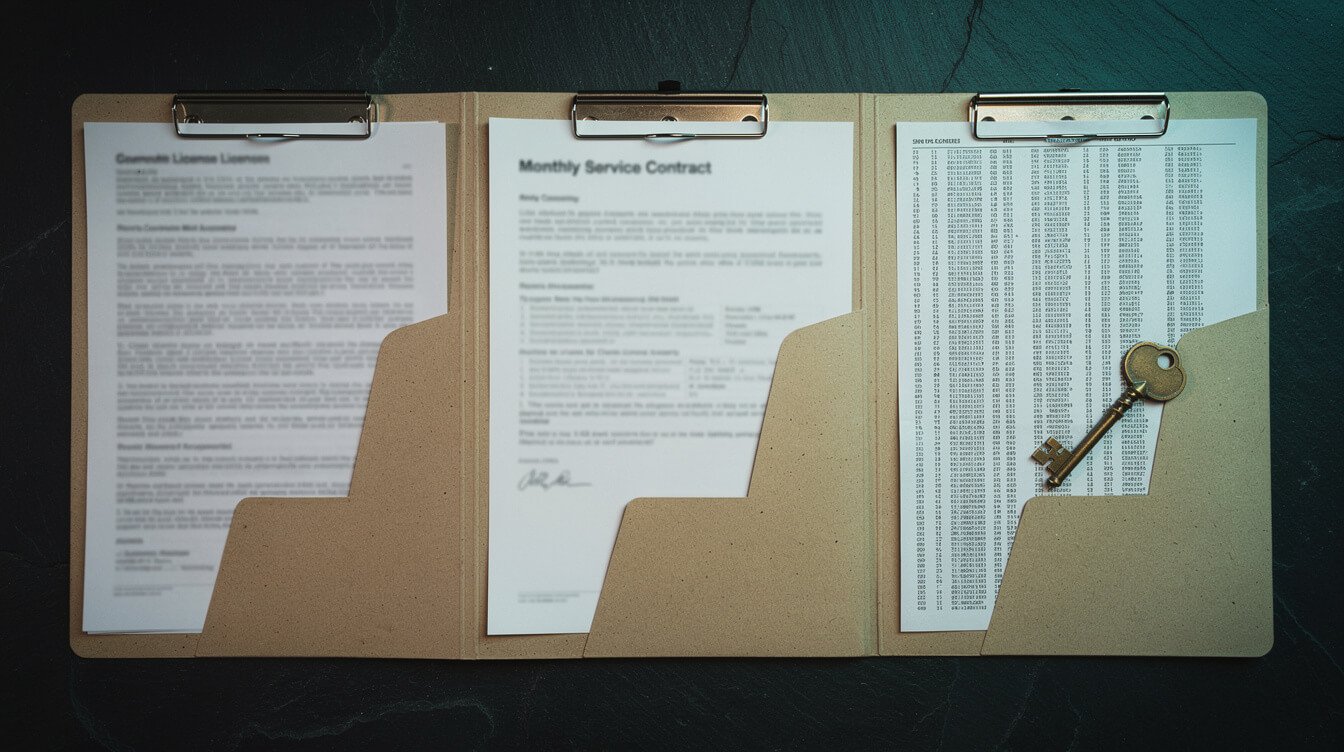
Before you talk to anyone, decide which of these you’re buying. Vendors will happily let you stay confused, because confusion is how a platform licence gets sold to someone who needed a build, and how a permanent retainer gets sold to someone who needed a two-week project.
Mode 1 — the platform. Zapier, Make, n8n, Power Automate. You pay for software. You do the building. Cheapest entry, fastest start, and every workflow that breaks at 2am is yours to fix.
Mode 2 — the managed service. An agency or provider designs, builds, and runs your automations. You pay monthly, more or less forever. You buy outcomes and speed. You also buy a dependency.
Mode 3 — the commissioned build. You pay someone to build a system, then you own it. Repo, credentials, documentation, the ability to change it without calling anyone. Highest upfront cost, lowest cost to keep.
Credit where it’s due: of everything ranking for this term, Moxo’s comparison is the only page that draws this distinction at all. It has a “three ways to buy” section, it names the orphaned-automation risk, and it asks who maintains things in month six. It’s genuinely the strongest result on the page, and I’m not going to pretend otherwise just because it’s a vendor blog.
Here’s what it still doesn’t do, and what nothing else on page one does either: price all three modes side by side. Moxo’s pricing table covers platform licences — real numbers, published. For managed services and commissioned builds, the column reads “Quoted,” or the mode simply isn’t priced. The enterprise directory results do carry dollar figures, but they’re minimum project budgets in agency profiles, not a comparison. So the buyer learns that three modes exist and then gets numbers for exactly one of them.
That’s the gap this post fills. Numbers for all three, and the ownership question answered as a decision rule instead of a reason to buy a particular product.
Mode 1: buying a platform — the real cost and the real ceiling

This is the mode with honest, published pricing, which is exactly why it’s the one everyone quotes. Per Moxo’s comparison table (their figures, dated August 2026): Zapier free tier with paid plans from $19.99/month. Make free with paid from $12/month. n8n free if you self-host, cloud from about €20/month. Microsoft Power Automate Premium at $15/user/month. At the enterprise end, Rossum starts at $18,000/year and UiPath, Workato and ServiceNow are quote-only.
For a solopreneur or a small team, the license is not your real cost. Your real cost is your time, and it shows up in two places.
First, the build. A genuinely useful multi-step workflow with error handling is not an afternoon. Second — and this is the one that gets underestimated — maintenance. An API changes. A credential expires. A rate limit throttles you. Somebody renames a spreadsheet column. Every one of those is now your Tuesday.
The ceiling is separate from the cost, and it’s the more important constraint. Task-based tools are extremely good at this happens, then do that. They get awkward the moment the work requires judgment — reading something ambiguous, deciding it doesn’t fit the usual pattern, and choosing a different path. You can approximate judgment with enough branches, but you end up maintaining a decision tree that a paragraph of instructions would have handled. I’ve written about where that wall sits in detail in n8n alternatives and Flowise AI, and the plain-English version of the whole category in what is AI automation.
Buy this mode if: you have someone who enjoys building, your processes are stable, and the work is genuinely trigger-and-action. It’s the right answer far more often than agencies would like you to believe.
Skip it if: nobody on the team wants to own it. An unowned automation platform becomes a graveyard of half-finished workflows, and you’ll pay the license for two years before anyone admits it.
Mode 2: buying a managed service — what renting forever actually totals

Now the pricing goes dark. This is where page one stops giving you numbers, so let me give you the shape of them from the directory data and from quoting this work myself.
Agency engagements in this category generally start with a build fee and continue as a retainer. Directory listings for automation agencies commonly show minimum project budgets in the $10,000 and $25,000 bands. Retainers scale with how much they’re running for you — a few hundred a month for light monitoring, several thousand if they operate business-critical processes.
Do the arithmetic that nobody on page one does for you. A $12,000 build plus a $1,500/month retainer is $30,000 over the first year and $18,000 every year after, forever, for as long as you need the thing to keep running. That is not a criticism — operating someone else’s systems is real work and it deserves real money. But you should see the total before you sign, not in year three.
What you’re genuinely buying is speed and the absence of a hiring decision. A good provider compresses time-to-value dramatically. Most of them build on the same platforms from Mode 1 — Make, n8n and Zapier are the common stack — so you’re paying for expertise and velocity, not secret technology. Anyone implying otherwise is selling mystique.
The risk is structural, not moral: you’re renting the ability to operate your own business processes. If the automations live in the provider’s workspace, on the provider’s accounts, with the logic in the provider’s head, then your switching cost rises every month while your leverage falls. That’s a bad trend in a contract you can’t easily exit.
Ask these three before signing: Whose accounts hold the credentials? If we part ways, what do I receive — and is that in writing? What does month-six support cost when something breaks at 9am on a Monday?

Get the AI Playbook
The systems I actually run, written up as build logs you can copy. No fluff, no filler.
Mode 3: commissioning a build you own — scope, price, and handover

This is the mode page one barely acknowledges, and I need to disclose plainly that it’s the mode I sell. Read the rest of this section with that in mind — then use the questions in it on me too.
A commissioned build is a project with an end. Someone scopes the work, builds the system on infrastructure you control, documents it, hands over the repository and the credentials, and leaves. After that you can hire anyone to maintain it, maintain it yourself, or let it run untouched.
Pricing looks like consulting pricing, because it is. Published market anchors put readiness audits in the $1,500–$4,000 range, strategy and roadmap work at $4,000–$10,000, and a working proof-of-concept build at $8,000–$20,000. A full production system with real error handling and monitoring sits at the top of that band or above it, depending on how many systems it has to touch.
The number that matters, though, is the one after handover — and this is where I can hand you actual receipts instead of an argument.
The container that wrote this post runs on metered APIs. Its images come from a Replicate model at roughly $0.08 per image; this post has seven of them, so about $0.56 of imagery. The keyword and SERP research behind it — live difficulty verification on seven terms plus a fifteen-result organic pull — cost $0.0288, metered, which I checked against the account balance before and after. Call it under sixty cents of API spend for the research and art of a three-thousand-word researched article.
Be honest about what that figure excludes: model inference for the writing itself, the VPS the container runs on, and the engineering that built the pipeline. Those are real and they are not free. What the number does prove is the shape of the cost curve in Mode 3. Once a system you own exists, the marginal cost of running it is measured in cents, not retainers. That’s the whole economic argument, and it’s why the upfront number is worth paying when the work is ongoing.

⚡ GET THE AI EDGE
Weekly AI tips that actually save you time and money. No fluff, no hype — just what works.
For the fuller picture of what that infrastructure actually costs to stand up and keep alive, I broke it down in self-hosted AI server, and the autonomous-systems version of the agency model in AI automation agency.
Buy this mode if: the process is core to your business, you’ll need it for years, and you don’t want a permanent line item. Skip it if the process is still changing shape weekly — build it cheap in Mode 1 first and commission it once it’s stable.
What an AI implementation consultant adds that a platform cannot

An ai implementation consultant is not a person who knows more software than you. Plenty of people know the tools. The job is narrower and harder than that, and it’s worth understanding before you decide you don’t need one.
The real work is deciding what to automate and in what order. Most businesses arrive with a list of twelve annoyances and no ranking. A good consultant ignores the loudest one and finds the task that is high-frequency, low-judgment and well-defined, because that’s where automation returns immediately and safely. Getting that sequence wrong is the most expensive mistake in this category — it’s how companies spend $15,000 automating something that happens twice a month.
The second thing they add is process repair before process automation. Automating a broken workflow gets you a broken workflow running faster. Half of the value in a good engagement is someone saying out loud that three of your five steps exist because of a decision made in 2021 that no longer applies.
Third: failure design. This is the tell that separates operators from demo-builders. Anyone can show you a workflow succeeding. Ask what happens when the API returns a 500, when a credential silently expires, when the model returns something malformed. If there’s no answer, you’re looking at a demo, not a system. I keep my own agents on this standard and still find gaps — a monitoring rule in my own fleet passed every failure it was supposed to catch for weeks before I measured what it actually admitted.
Whether you need one is a scope question. Buying Mode 1 for a simple, stable process? Probably not. Automating something that touches money, customers or a regulator? The sequencing and failure design are worth more than the build. More on how the role is priced in AI automation consultant and “AI consultant near me”.
How to read an AI automation company’s proposal — the four line items that are padding

When you request quotes, you’ll get documents that are hard to compare on purpose. Any ai automation company worth hiring will survive these four questions. The ones that aren’t will get defensive.
1. “Discovery” priced like a deliverable. Understanding your process is legitimate work. A five-figure discovery phase that produces a slide deck and no working software is a way to bill for the sales cycle. Fair version: a short paid audit with a fixed fee and a written artifact you keep — a process map, a ranked automation list, a cost estimate — usable even if you never hire them.
2. “Custom AI model development” that isn’t. Ask directly: are you training a model, or are you calling Claude or GPT with a well-written prompt? Calling a frontier model is the correct answer almost every time. It’s also dramatically cheaper than training, so it must not be priced as bespoke ML research. Overwhelmingly this line item means prompt engineering with a better name.
3. Per-seat pricing on a system with no seats. Autonomous back-office automation doesn’t have users; it has processes. If a proposal is priced per employee for something no employee logs into, the pricing model was chosen for the vendor’s revenue rather than your usage.
4. Open-ended “ongoing optimisation.” This is the one that becomes permanent. Ask what specifically gets optimised, how it’s measured, and what the exit looks like. A real support agreement has a scope and a response time. “Optimisation” with no metric is a subscription with no ceiling.
And one question that outranks all four — ask for the artifact, not the deck. Ask to see a system they built that is running right now: the logs, the error handling, the thing working. Operators produce this in minutes because it exists. Resellers produce case-study PDFs and testimonials. This single request sorts the field faster than any reference call, and it’s the test I’d want a prospect to run on me. Comparison framework in best AI agency and the current tool landscape in AI tools for business.
The ownership test: when we’re done, what do I actually hold?
If you take one thing from this page, take this question. Ask every vendor in every mode, and listen to how fast the answer comes.
When this engagement ends, what do I hold? Name the specific assets — accounts, repository, credentials, documentation — and tell me whose name they’re in.
Good answers are immediate and concrete, because the person has thought about it. Bad answers arrive as reassurance: don’t worry, we’ll always be here. That isn’t an answer to the question. It’s a description of your dependency read back to you as comfort.
Run it against the three modes and the differences stop being abstract:
- Mode 1 — platform: you hold the account and the workflow logic. You’re exposed to the vendor’s pricing and to your own maintenance capacity. Real ownership inside someone else’s walls.
- Mode 2 — managed service: you may hold nothing but a working outcome. That can be a perfectly good trade for speed. It is only a bad one if nobody told you it was the trade.
- Mode 3 — commissioned build: you hold the repository, the credentials and the documentation. You also hold the responsibility, which is the honest cost of the mode.
There’s no universally correct answer. There is a correct process: pick the mode deliberately, then price that mode instead of letting a vendor pick for you. Every page ranking for ai automation services wants to answer this question with its own product. You can just ask it.
FAQ: AI Automation Services Pricing, Timelines, and What Happens When You Stop Paying
How much do AI automation services cost?
It depends entirely on which of the three you buy. Platforms: $12–$20/month at the low end, $15/user/month for Power Automate, $18,000/year and up for enterprise document tooling. Managed services: commonly a build fee with minimums in the $10,000–$25,000 range plus a monthly retainer. Commissioned builds: audits $1,500–$4,000, roadmaps $4,000–$10,000, working builds $8,000–$20,000 and up. Anyone quoting a single number for “AI automation services” hasn’t asked which one you need.
How long does implementation take?
A single well-defined workflow on an existing platform: days. A production system spanning several tools with real error handling: weeks. Enterprise platform rollouts through a partner ecosystem: quarters. If a timeline sounds impossibly short, check whether it covers the failure cases or only the happy path — that’s usually the missing work.
What happens when I stop paying?
The sharpest question in this entire category. Platform: workflows stop, and on most tools you can export the logic. Managed service: everything stops, and whether you can rebuild depends on access you probably should have negotiated at signing. Commissioned build you own: nothing stops. It keeps running on your infrastructure at metered cost until you change it. That asymmetry is the strongest argument for Mode 3 and the reason I’d rather hand over a repo than hold one hostage.
Do I need an AI automation company, or can I do this myself?
If your processes are stable and trigger-based and somebody on the team genuinely wants to own the tooling, do it yourself in Mode 1. Bring in help when the work requires judgment rather than rules, when it touches money or customers, or when the sequencing decision is beyond you — that last one is worth paying for even if you build the rest.
Is an AI implementation consultant different from an AI automation agency?
Usually, yes. A consultant is typically engaged to decide what to automate and in what order, and may not build it. An agency builds and often runs it. Some do both, which is efficient but means the person recommending the scope is the person billing for it. Not disqualifying — just ask how scope decisions get made, and notice who benefits when scope grows.
Final thoughts: pick the mode, then price it
The reason this search is frustrating isn’t a shortage of vendors. It’s that one phrase covers three different contracts, and almost every page ranking for it is quietly optimising for the mode its author sells. Moxo is the best of them and it still resolves every question with “buy Moxo.” I sell Mode 3, and I’ve told you so three times on this page so you can discount accordingly.
So do this instead. Decide which of the three you’re buying before the first call. Price that mode specifically. Then ask the ownership question and time how long the answer takes.
The vendors worth hiring answer it in one sentence. That’s the filter. Open a doc, write down your three most repetitive processes, mark which mode each one deserves, and you’ve done more useful thinking than any brochure on page one will do for you.
If you want a second opinion on that list from someone who operates these systems daily — and who will tell you when Mode 1 is the honest answer and you don’t need me — book an automation strategy session. Bring the list. Let’s build.
Get the AI Playbook
Build logs from the containers that run my businesses — the real systems, with the receipts. One email, no filler.
📥 FREE: THE AI PLAYBOOK
The exact tools and workflows I use to run a one-person agency. 25 years of marketing experience distilled into an actionable guide. Yours free.

AI & Digital Marketing Strategist
With over 25 years in digital marketing, e-commerce, sales, and international business, Jon Jones is a seasoned entrepreneur dedicated to empowering small businesses through innovative AI solutions. His journey began in investment banking on Wall Street, guiding companies through capital acquisition and complex markets, and has expanded to include expertise in web development, brand design, product development, and courses and training.
Fluent in Mandarin and with a rich foundation in both finance and tech, Jon launched JonJones.ai to provide accessible, transformative tools for small businesses to streamline operations, generate leads, and build sustainable growth. His mastery of AI, automation, and digital strategy has enabled numerous businesses to bridge the gap between traditional practices and modern technology, ensuring they thrive in today’s digital landscape.