
Ask ten founders what an AI sales agent is and you’ll get ten answers, most of them wrong. Some picture a chatbot bolted onto a website. Some picture a robot stealing their sales team’s jobs. And a lot of them picture a $2,000-a-month SaaS seat that promises “autonomous pipeline” and quietly delivers a glorified email scheduler. After running autonomous agents across a fleet of ten businesses, I can tell you the truth is more useful — and more profitable — than any of those cartoons.
This is the operator’s guide I wish existed when I started. No vendor spin, no breathless “AI will 10x your revenue” nonsense. Just what an AI sales agent actually is, what it genuinely costs in 2026, when to buy one off the shelf versus build your own, and a 30/60/90-day plan to get one earning its keep. If you run a small team — or you are the team — this is written for you.
What Is an AI Sales Agent, Really?

An AI sales agent is software that can take a goal — “book qualified demos,” “follow up with every inbound lead within five minutes,” “keep the CRM clean” — and then plan and execute the steps to hit it, largely on its own. The keyword is agent. Unlike a chatbot that only answers when spoken to, an agent decides what to do next, calls tools (your CRM, your calendar, your email), and loops until the job is done or it hits a boundary you set.
It helps to separate it from two things it gets confused with. A chatbot is reactive: it waits for a message and replies. An AI sales agent is proactive: it can start conversations, enrich a lead, draft the follow-up, and schedule the call. It’s also broader than an AI SDR, which is specifically the top-of-funnel prospecting role — an AI sales agent can cover the SDR job and qualification, follow-up, quoting, and CRM hygiene across the whole cycle.
Assistive vs. autonomous: the two kinds that matter
Every real product on the market lands somewhere on a spectrum between two poles, and knowing which you’re buying saves you a world of disappointment:
- Assistive agents sit next to a human and speed them up — drafting emails, summarizing calls, suggesting the next action. The human still pulls the trigger. Low risk, fast payback, easy to trust.
- Autonomous agents run a workflow end-to-end without a human in the loop for each step — they qualify, respond, and book while you sleep. Higher leverage, higher stakes, and they demand tighter guardrails.
Most vendors sell you “autonomous” and ship you “assistive with extra steps.” That’s not always bad — assistive is where most small teams should start — but you should know exactly which one you’re paying for.
What an AI Sales Agent Actually Does All Day

Forget the marketing. Here’s the concrete work a well-configured agent handles, in roughly the order a lead experiences it:
- Lead capture and enrichment. A form fills in, and the agent instantly pulls company size, role, and recent signals, then scores the lead against your ideal-customer profile.
- Instant qualification and response. The lead gets a relevant, personalized reply in minutes — not the next business day. Speed-to-lead is still the most underrated conversion lever in sales, and this is where agents crush human teams.
- Multi-touch follow-up. The agent runs the boring, disciplined sequence humans always let slip — five, seven, nine touches across email and, increasingly, voice and SMS.
- Meeting booking. It reads the calendar, offers times, handles the back-and-forth, and drops the call on both calendars.
- CRM hygiene. Every interaction is logged, tagged, and updated without a rep touching a keyboard — the single most-hated task in sales, gone.
- Handoff with context. When a lead is genuinely ready, the agent hands a warm, fully-briefed opportunity to a human closer instead of a cold name in a list.
Notice what’s missing: the agent isn’t closing your $50k enterprise deal or negotiating a contract. It’s clearing the 80% of repetitive pipeline work that keeps humans from doing the 20% that actually needs a human. That’s the whole game. If you want the same logic applied to the top of the funnel, my breakdown of the AI marketing agent pairs neatly with this.
A real receipt from the fleet
Here’s a concrete example instead of a hypothetical. On one of the brands I run, inbound leads used to sit in an inbox until someone got to them — sometimes hours, sometimes a day. I wired up an agent to watch the form endpoint, enrich each lead, score it against the ICP, and send a genuinely personalized first reply within a couple of minutes, then log everything to the CRM and book a call if the lead asked for one. No human touched the first response. The agent doesn’t get tired at 11pm, doesn’t forget the fourth follow-up, and doesn’t “circle back next week.” It just runs. That’s not a demo — it’s a container that has been quietly working the pipeline for months, and the marginal cost of it doing so is a rounding error. The point isn’t that the tech is magic; it’s that consistency is the thing humans are worst at and agents are best at.
What an AI Sales Agent Actually Costs in 2026

This is where the honest math lives, and where most articles go quiet. There are two ways to pay for an AI sales agent, and they cost wildly different amounts.
Option 1: Buy a SaaS seat
Off-the-shelf AI sales platforms in 2026 generally run $300 to $1,500 per seat per month, with the “autonomous SDR” products clustering around $1,000–$2,000/month per agent, often with annual contracts and setup fees on top. You’re paying for a polished UI, integrations that mostly work, and someone else’s roadmap. For a team that wants results next week and has no appetite for building, this is the fast lane.
Option 2: Build your own
Here’s the receipt most vendors don’t want you to see. The underlying intelligence — the LLM doing the reasoning — costs a few dollars per million tokens. A single agent handling a few hundred leads a month might burn $20–$80 in model costs, plus whatever you spend on the plumbing (a workflow tool, a database, enrichment APIs). I run agents across ten brands, and the marginal cost of one more agent doing real work is closer to a nice dinner than a car payment.
The catch is obvious: building requires time and technical judgment. But the tools have collapsed the barrier. With a workflow platform like n8n or a coding agent like Claude Code, a determined operator can stand up a working agent in a weekend that would cost thousands a month to rent. You’re trading upfront effort for near-zero marginal cost forever after — the exact trade that makes the fleet model work.
A worked example
Say you’re handling 400 inbound leads a month. Rent an “autonomous SDR” seat and you’re looking at roughly $1,200/month — call it $14,400 a year, plus onboarding, plus whatever the price is when they raise it next renewal. Build the same capability yourself and the ongoing bill is the model usage (a few hundred leads’ worth of reasoning and drafting lands around $30–$60/month), a workflow tool (often $20–$50/month), and enrichment credits if you use them. Round it up generously to $150/month, or $1,800 a year — and that number barely moves whether you run one agent or five. The build costs you a weekend of setup and the willingness to maintain it. Over a single year the gap is roughly $12k; over three years, with a second and third agent added, the SaaS path costs multiples of the build. That is the entire economic argument for owning your automation instead of renting it, and it’s why I build.

Steal My AI Playbook
The exact stack and prompts I use to run autonomous agents across ten businesses. Free, no fluff — get it straight to your inbox.
Build vs. Buy: Should You Own Your AI Sales Agent?

This is the decision that actually matters, so let’s make it simple. Buy when speed beats ownership. Build when ownership beats speed.
Buy an off-the-shelf agent if: you need pipeline this quarter, you have budget but not technical time, your process is fairly standard, and you’re fine renting a capability you don’t control. There’s no shame in it — a rented agent that ships beats a custom one that never gets finished.

⚡ GET THE AI EDGE
Weekly AI tips that actually save you time and money. No fluff, no hype — just what works.
Build your own agent if: your sales motion is even slightly unusual, you care about margins at scale, you want the data and logic to stay yours, or you plan to run more than one agent. The moment you’d be paying for three or four SaaS seats, the build math flips hard in your favor. This is the same build-vs-buy logic I walked through for the AI chatbot for business — the framework is identical, only the job changes.
My honest bias, as someone who builds: most small teams should buy first to learn, then build to scale. Rent an agent for 60 days to understand exactly what “good” looks like in your funnel. Then rebuild the parts that are core to you and keep renting the parts that aren’t. You get speed now and ownership later.
Your 30/60/90-Day AI Sales Agent Deployment Playbook
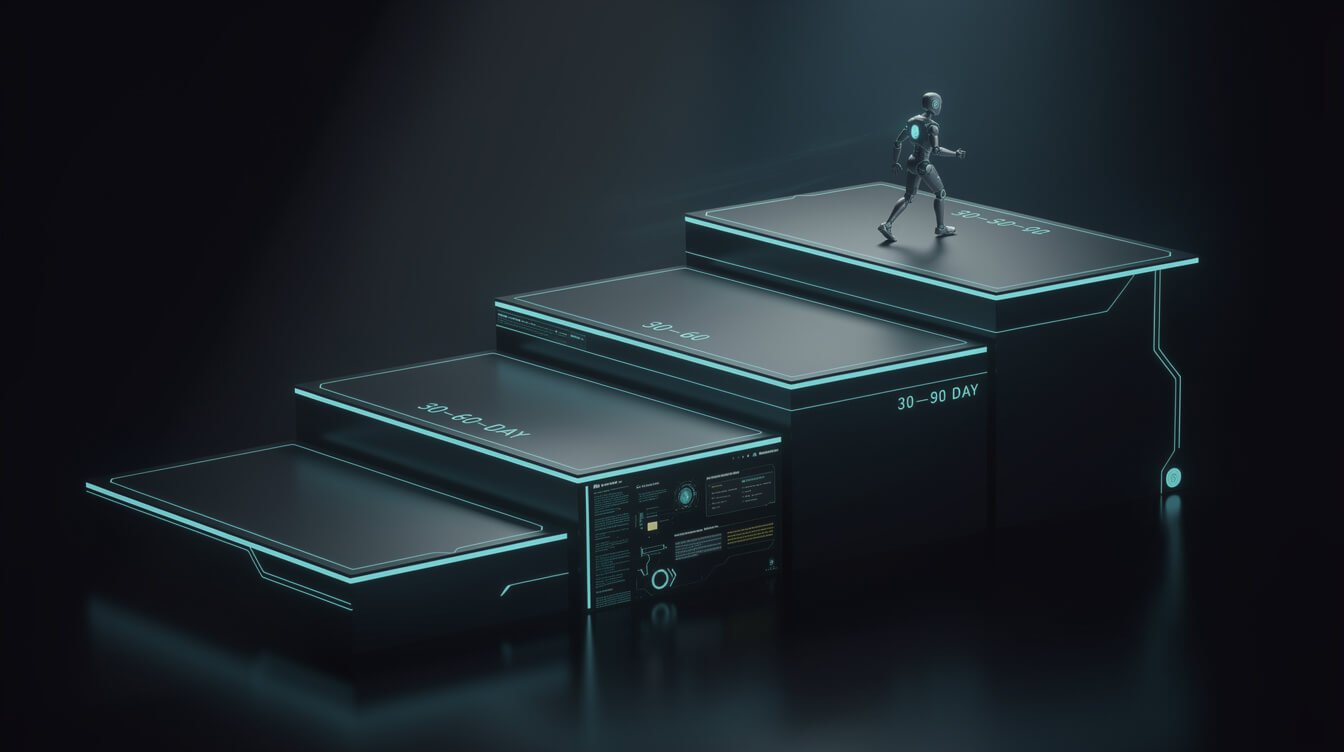
Deploying an agent fails when people try to automate everything at once. Do it in stages instead, and let each win fund the next.
Days 1–30: One job, one metric
Pick the single highest-pain, lowest-risk task. For almost everyone that’s speed-to-lead: the moment a lead comes in, the agent responds and qualifies. Keep a human reviewing every message before it sends. Your only goal this month is to prove the agent is reliable and on-brand. Measure one number — response time — and watch it drop from hours to minutes.
Days 31–60: Loosen the leash
Once you trust the drafts, let the agent send routine responses on its own and add the full follow-up sequence and meeting booking. Now it’s running multi-touch cadences and filling calendars while you sleep. Add CRM logging so every touch is captured automatically. You should feel your own inbox getting quieter.
Days 61–90: Expand and connect
With a trusted agent running the mechanical middle of your funnel, expand its reach — enrichment, lead scoring, maybe a second agent for reactivation of old leads. This is also where you connect it to the rest of your stack, the way I wire agents into email marketing and automation so a single lead flows from first touch to nurtured contact without a human relay. By day 90 you’re not “testing AI” — you’re running a system.
Where AI Sales Agents Still Fail (Don’t Automate These Yet)

An honest guide tells you the boundaries. Here’s where I still keep a human firmly in charge:
- High-stakes negotiation. Pricing exceptions, contract terms, and “I’m about to churn” conversations need human judgment and human accountability. Let the agent tee it up, not close it.
- Genuine relationship moments. The strategic account that closes on trust doesn’t want to be nurtured by a bot, and can tell when it is.
- Anything unmonitored on day one. An agent let loose with no guardrails will confidently email the wrong thing to the wrong person at scale. Set spend limits, approval gates, and a kill switch before you ever go autonomous.
- Compliance-sensitive claims. In regulated industries, an agent that improvises a promise creates real liability. Constrain what it’s allowed to say.
The operators who win with AI aren’t the ones who automate the most — they’re the ones who automate the right things and keep a human on the high-value, high-risk edges. If you want to see the tooling side of how these agents connect to your systems, my rundown of the best MCP servers shows what’s under the hood.
Frequently Asked Questions
Can an AI sales agent replace my sales team?
No — and anyone selling you that is lying. It replaces the repetitive tasks your team hates, not the humans. Small teams use it to punch far above their weight; a solo founder can suddenly cover the follow-up discipline of a three-person SDR desk. It makes your people more valuable, not redundant.
How much does an AI sales agent cost to run?
Renting a SaaS agent runs roughly $300–$2,000 per month per seat. Building your own drops the ongoing cost to tens of dollars a month in model usage plus a little plumbing, in exchange for upfront setup time. Which is cheaper depends entirely on how many agents you’ll run and how much you value control.
How long until an AI sales agent pays for itself?
If you point it at speed-to-lead first, fast. Responding to inbound leads in minutes instead of hours routinely lifts conversion enough to cover the cost within the first month or two. Start where the payback is obvious, not where the demo is flashy.
Do I need to know how to code to use one?
To buy one, no — the SaaS products are point-and-click. To build one, less than you’d think. Modern workflow tools and coding agents mean a non-engineer with patience can assemble a real agent. The bottleneck is clear thinking about your process, not syntax.
What’s the difference between an AI sales agent and an AI SDR?
An AI SDR is a specialist — it does top-of-funnel prospecting: sourcing leads, sending the first outbound touches, and qualifying interest. An AI sales agent is the broader category; it can play the SDR role and also handle inbound qualification, follow-up cadences, meeting booking, quoting, and CRM hygiene across the whole cycle. Think of the SDR as one job an agent can hold, not a separate species.
Is it safe to let an AI sales agent talk to customers unsupervised?
Only after you’ve earned that trust in stages. Start with a human approving every message, watch it for a few weeks, and only then let it send routine responses on its own — always inside guardrails like spend limits, approval gates for anything unusual, and a kill switch. Autonomy is something you grant gradually, not a switch you flip on day one.
Final Thoughts
An AI sales agent isn’t a magic revenue machine and it isn’t a threat to your team. It’s leverage — a way for a small operation to run the disciplined, tireless, always-on pipeline work that used to require a headcount you couldn’t afford. The winners in 2026 won’t be the companies with the biggest sales teams. They’ll be the operators who deployed an agent to handle the mechanical 80%, kept humans on the meaningful 20%, and quietly out-executed everyone still doing it all by hand.
Start small. Pick one job, prove it, and expand. Buy to learn, build to scale. That’s the whole playbook — now go put an agent to work.
Want the Whole System?
Grab the free AI Playbook — the stack, prompts, and workflows I use to run autonomous agents across ten businesses. One email, real receipts, zero fluff.
📥 FREE: THE AI PLAYBOOK
The exact tools and workflows I use to run a one-person agency. 25 years of marketing experience distilled into an actionable guide. Yours free.

AI & Digital Marketing Strategist
With over 25 years in digital marketing, e-commerce, sales, and international business, Jon Jones is a seasoned entrepreneur dedicated to empowering small businesses through innovative AI solutions. His journey began in investment banking on Wall Street, guiding companies through capital acquisition and complex markets, and has expanded to include expertise in web development, brand design, product development, and courses and training.
Fluent in Mandarin and with a rich foundation in both finance and tech, Jon launched JonJones.ai to provide accessible, transformative tools for small businesses to streamline operations, generate leads, and build sustainable growth. His mastery of AI, automation, and digital strategy has enabled numerous businesses to bridge the gap between traditional practices and modern technology, ensuring they thrive in today’s digital landscape.