

Everyone selling you an ai marketing agent right now is selling you a chatbot with a new hat. You book a demo, sit through a deck about “agentic marketing,” and walk away with a glorified autocomplete bolted onto software you already pay too much for. I run a different setup: my brand’s marketing — the blog you’re reading, the social posts, the newsletter, the SEO housekeeping — is genuinely run by autonomous agents. No marketing team. No agency retainer. Just an operator and a fleet of agents that do the work while I sleep.
So this isn’t another listicle written by someone who watched a webinar. This is what an ai marketing agent actually is when you strip the vendor gloss off it, what it can realistically own in 2026, and how to build your first one without a team or a budget. I’ll show you the parts that work and the parts that break — because the ones that break are the parts nobody selling you a subscription will mention.
What an AI Marketing Agent Actually Is (and What It Isn’t)

Here’s the definition that cuts through the noise: an ai marketing agent is software that can take a goal, decide the steps to reach it, use tools to execute those steps, and check its own work — with little or no human in the loop. The keyword is decide. If a human has to click “generate” every time, you don’t have an agent. You have a very expensive text box.
Three things get lumped together and it’s costing people money to confuse them:
- A chatbot answers when spoken to. It’s reactive. It waits for a prompt, responds, and forgets. Useful, but it does nothing while you’re asleep.
- A workflow (think Zapier or Make) fires a fixed chain of steps when a trigger hits. It’s deterministic — same input, same path, every time. It can’t handle “the draft is weak, rewrite it with a sharper hook.”
- An agent holds a goal, picks its own steps, and adapts when reality doesn’t match the plan. It reads the situation, chooses a tool, evaluates the result, and loops until the goal is met or it hits a guardrail.
Most products marketed as an “AI marketing agent” are actually the first two wearing the third one’s costume. That’s not always bad — a good workflow beats a flaky agent for anything repetitive and well-defined. But you should know which one you’re buying, because the pricing assumes you won’t. If you want the deeper cut on where chatbots end and agents begin, I broke it down in my Botpress review, where the whole question is “is this actually an agent, or a decision tree with good marketing?”
What I Actually Run: Marketing on Autonomous Agents (With Receipts)

Let me get concrete, because “agents run my marketing” sounds like a slogan until you see the plumbing. Every one of my brands runs inside its own container. On a schedule, an agent wakes up, executes one specific job, logs the result, and goes back to sleep. Nothing about this is theoretical — this exact post was written and published by one of those agents.
The blog agent doesn’t just spit out text. It pulls the next keyword from a queue, checks whether I’ve already got a post targeting it (so I don’t cannibalize my own rankings), scrapes the current top-ranking pages to see what’s actually winning, writes the draft in my voice, generates its own images, sets the SEO metadata, and publishes — then logs the whole thing to a task board so I can review it over coffee. That’s not a chatbot answering a question. That’s an ai marketing agent owning an outcome end to end.
The social agents take that published post and reshape it per platform — different hook for LinkedIn, different length for a Threads post, a vertical video for the short-form networks. One piece of content, distributed everywhere, no copy-paste. I wrote up exactly how that fan-out works in Build Once, Ship Everywhere, and the full publishing pipeline in the 7-step pipeline that publishes this blog while I sleep.
The point isn’t “look how clever my setup is.” The point is that this is achievable, right now, with tools you can buy or build today. The gap between “vendor demo” and “actually running in production” is smaller than the enterprise sales teams want you to believe — and bigger than the no-code influencers want you to believe. The truth lives in the middle, and that’s where the money is.
The Six Jobs an AI Marketing Agent Can Own Right Now
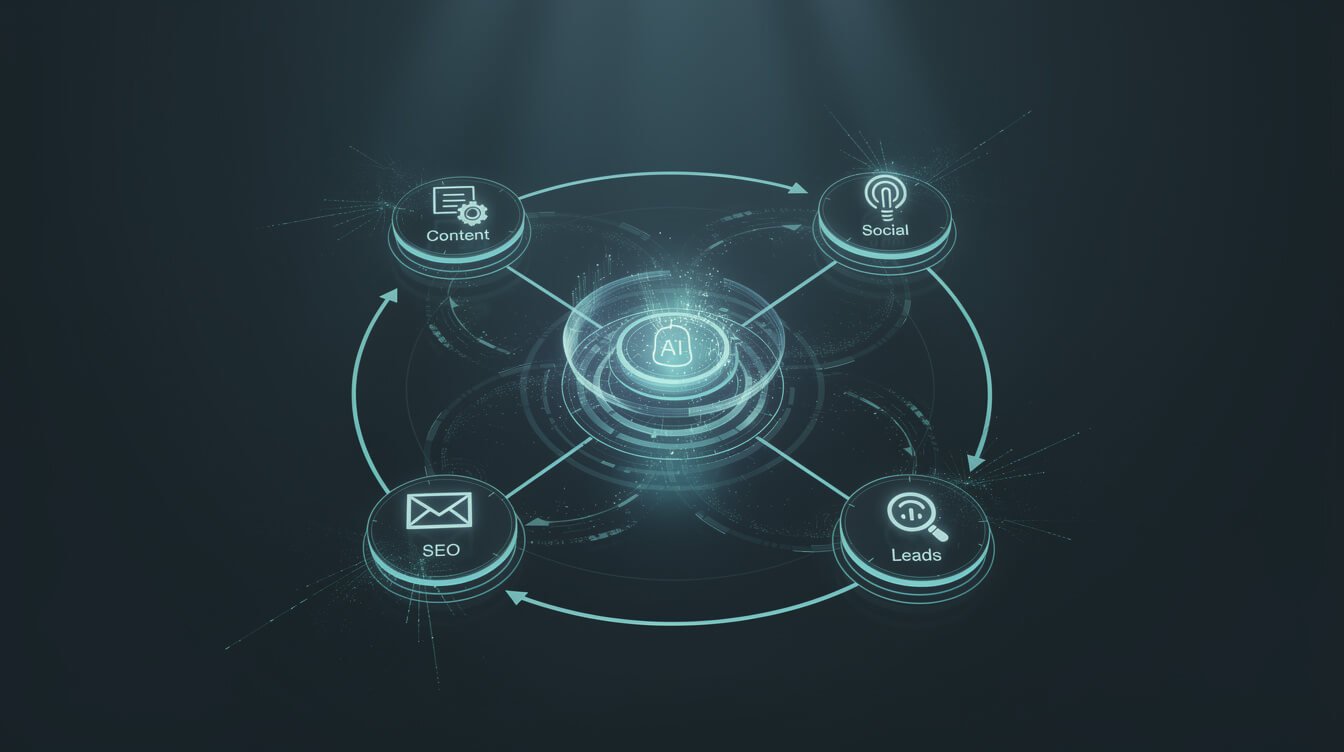
Not every marketing task is agent-ready. The ones that are share a pattern: they’re repetitive enough to define, but variable enough that a rigid workflow chokes on them. Here are the six I’d hand over first, roughly in order of how safe they are to automate.
- Content production. Blog posts, newsletters, product descriptions. This is the most mature use case — an agent that researches, drafts in your voice, and publishes. High leverage, and the failure mode (a mediocre draft) is cheap to catch.
- Social distribution. Repurposing one asset into platform-native posts and scheduling them. The agent handles the tedious reshaping; you keep the strategy.
- SEO maintenance. Watching which pages are slipping in rank and refreshing them before they fall off page one. Boring, endless, perfect for an agent that never gets bored.
- Email sequences. Drafting and personalizing nurture sequences, then triggering them off behavior. Pair it with a human-approval gate on anything that goes to your whole list.
- Lead research and qualification. Enriching inbound leads, scoring them, and drafting the first-touch reply. The agent does the digging; you decide who’s worth your time.
- Reporting. Pulling analytics, spotting what moved, and writing the plain-English summary you’d otherwise pay someone to assemble every Monday.
Notice what’s not on that list: strategy, positioning, and the actual decision about what your brand stands for. Agents execute marketing. They don’t decide what the marketing should say about who you are. That’s still your job — and honestly, it’s the job worth keeping.

Steal My AI Playbook
Get the exact playbook I use to run autonomous marketing agents across a fleet of brands — no team, no fluff. Free, straight to your inbox.
AI Marketing Agent vs. the Tools Everyone’s Selling You

Search “ai marketing agent” and you’ll get two kinds of results. The first is enterprise platforms — Salesforce Agentforce, HubSpot Breeze, Adobe’s stack — pitching “agentic marketing” to companies with a marketing department and a procurement process. The second is listicles ranking ten tools, usually written to funnel you toward whichever one paid for placement. Neither is written for a solo operator or a lean team, and both quietly assume you have budget to burn.
Here’s the honest breakdown. The enterprise platforms are genuinely powerful, but they price per seat and per contact, and their agents live inside their walled garden — great if you’re already all-in on their ecosystem, painful if you’re not. The point-solution tools (Jasper for content, a separate one for social, another for email) each do one thing well but leave you stitching together a Frankenstein stack that doesn’t share context. Your content tool doesn’t know what your email tool sent.
The third path — the one almost nobody sells because there’s no subscription in it for them — is building your own agents on top of general-purpose tooling like Claude Code or an open framework, so a single agent has context across your whole funnel. It’s more work upfront and infinitely cheaper and more flexible after. I compared the two agent runtimes I actually build on in Claude Code vs Codex if you want to go deeper on the tooling choice.
This is also where a lot of solopreneurs get stuck — not because the tech is too hard, but because nobody neutral is telling them which path fits their situation. That’s literally the work I do: if you’d rather have someone map your funnel and build the agents for you than spend three months learning it, that’s what my done-for-you automation builds are for. Either way, pick the path on purpose instead of defaulting to whatever ranked #1 for a keyword.
How to Build Your First AI Marketing Agent (Without a Team or a Budget)

Don’t start by trying to automate your whole marketing operation. That’s how people end up with a half-built system they don’t trust and quietly abandon. Start with one job, prove it, then expand. Here’s the sequence I’d follow if I were starting today.
Step 1: Pick the most boring repetitive task you do weekly. Not the most impressive one — the most tedious. Repurposing a blog post into social captions. Writing the weekly analytics summary. The tedium is the signal: if it bores you, it’s structured enough for an agent.
Step 2: Write the task down as if you’re training a new hire. Every step, every rule, every “if this then that.” This document becomes your agent’s instructions. If you can’t write it clearly for a human, an agent won’t do it either. This step alone teaches you whether the task is actually agent-ready.

⚡ GET THE AI EDGE
Weekly AI tips that actually save you time and money. No fluff, no hype — just what works.
Step 3: Give the agent real tools, not just a chat window. The difference between a toy and a worker is tool access — the ability to publish to your site, post to a platform, read your analytics. This is where Claude Code and similar agent runtimes pull ahead of a plain chatbot: they can actually touch your systems.
Step 4: Run it with a human gate for two weeks. The agent does the work; you approve before anything goes live. You’re not just catching errors — you’re learning where it’s reliable and where it needs a firmer rule. After two weeks you’ll know exactly which parts you can let run unattended.
Step 5: Remove the gate on the parts that earned it. Let the reliable steps run autonomously. Keep the gate on anything high-stakes — a send to your whole list, a public claim about a customer. Autonomy is earned per-task, not granted all at once.
That’s the whole method. It’s not glamorous and it doesn’t require a budget — it requires you to be honest about which tasks are actually structured and to resist the urge to automate everything on day one. If you want a more complete walk-through of learning to build this way, my honest take on AI automation courses covers what’s worth your time and what’s just repackaged prompt tips.
Where AI Marketing Agents Break (The Honest Failure Modes)

Every vendor page ends on a triumphant note. Mine won’t, because the failure modes are the whole reason most people’s agent projects die quietly. Know these going in and you’ll dodge the traps that make people give up.
They drift when the goal is fuzzy. Give an agent a vague objective — “make our brand more engaging” — and it’ll wander. Agents need concrete, checkable goals. “Publish one SEO post targeting this keyword with a featured image” works. “Improve our vibe” does not.
They fail silently if you don’t watch them. An agent that errors at 2 a.m. and doesn’t tell you is worse than no agent at all, because you’ll assume the work got done. Every agent I run fires an alert on both success and failure. If you can’t see what it did, you don’t have automation — you have a liability with a schedule.
They confidently produce plausible garbage. An agent will write a factually wrong sentence with total confidence. For anything customer-facing or factual, you need a verification step — the agent checks its own output against source material, or a human checks it, before it ships.
They’re only as good as their context. An agent that doesn’t know your brand voice, your past content, or your customer will produce generic mush. The unglamorous work of feeding it good context is what separates agents that sound like you from agents that sound like everyone else’s ChatGPT.
None of these are reasons to avoid agents. They’re reasons to build them deliberately — with clear goals, alerting, verification, and real context. Skip those four and you’ll be one of the people who tried an “ai marketing agent” once and decided the whole category was hype.
Frequently Asked Questions
What’s the difference between an AI marketing agent and marketing automation?
Traditional marketing automation runs fixed workflows — a fixed trigger fires a fixed sequence. An ai marketing agent holds a goal and decides its own steps, adapting when the situation changes. Automation follows a script; an agent writes its own within the guardrails you set.
Can an AI marketing agent replace a marketing team?
It can replace the execution work of a small team — the writing, repurposing, scheduling, and reporting. It can’t replace strategy, brand positioning, or judgment about what your marketing should say. In practice, one operator plus agents can now do what used to take several people, but the operator still owns the thinking.
How much does it cost to run an AI marketing agent?
If you build on general-purpose tooling, your real cost is the underlying model usage plus whatever services the agent touches — often tens of dollars a month for a solo operation, not the per-seat enterprise pricing the big platforms quote. The bigger cost is the upfront time to build and tune it.
Do I need to code to build one?
Less than you’d think, and more than the no-code crowd claims. Modern agent runtimes let you describe tasks in plain language, but connecting real tools and debugging behavior rewards a bit of technical comfort. You don’t need to be an engineer; you do need to be willing to get your hands dirty.
What should my first AI marketing agent do?
The most boring repetitive task on your weekly list — usually content repurposing or reporting. Prove one agent on one narrow job, then expand. Starting small is the single biggest predictor of whether you’ll still be running agents in six months.
Final Thoughts
An ai marketing agent isn’t a magic box you buy and forget. It’s a worker you build, train, and supervise until it earns the right to run unattended. The people selling you a one-click subscription are skipping the parts that matter — the clear goals, the alerting, the verification, the context. Do those parts and you get what I have: marketing that runs itself while you focus on the decisions only you can make.
Start with one boring task this week. Write it down like you’re training a new hire. Give the agent real tools and a human gate. In two weeks you’ll know whether to hand it the keys — and you’ll understand agents better than anyone who’s only read the vendor decks. That’s the whole game: build one that works, then build the next.
Run Your Marketing While You Sleep
I send the real build logs, playbooks, and receipts from running autonomous agents across a fleet of brands. Grab the free AI Playbook and follow along.
📥 FREE: THE AI PLAYBOOK
The exact tools and workflows I use to run a one-person agency. 25 years of marketing experience distilled into an actionable guide. Yours free.

AI & Digital Marketing Strategist
With over 25 years in digital marketing, e-commerce, sales, and international business, Jon Jones is a seasoned entrepreneur dedicated to empowering small businesses through innovative AI solutions. His journey began in investment banking on Wall Street, guiding companies through capital acquisition and complex markets, and has expanded to include expertise in web development, brand design, product development, and courses and training.
Fluent in Mandarin and with a rich foundation in both finance and tech, Jon launched JonJones.ai to provide accessible, transformative tools for small businesses to streamline operations, generate leads, and build sustainable growth. His mastery of AI, automation, and digital strategy has enabled numerous businesses to bridge the gap between traditional practices and modern technology, ensuring they thrive in today’s digital landscape.