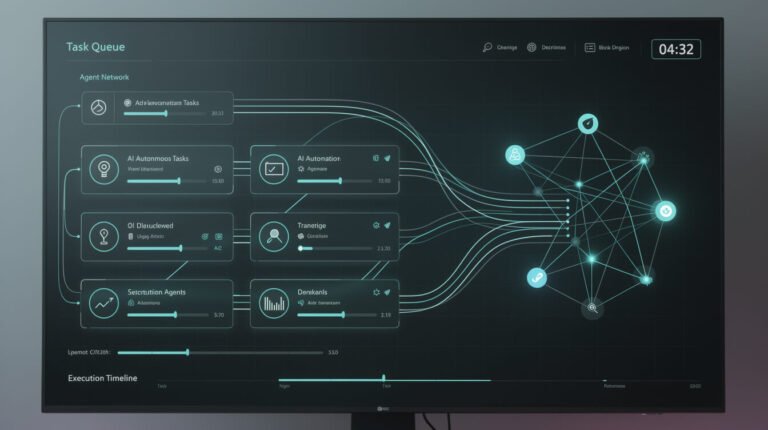

Ask ten vendors what a fully autonomous AI agent is and you’ll get ten glossy answers that all quietly mean the same thing: “buy our platform.” I run autonomous agents for a living — ten separate brands, each with its own agent working on a cron schedule inside its own container — so let me give you the version nobody selling you software will: a fully autonomous AI agent is software that perceives a situation, decides what to do, does it, checks its own work, and moves on without a human in the loop for that run. That last clause is where the marketing and the reality part ways.
This guide is the honest one. We’ll define the term properly, walk through how these agents actually work under the hood, and then get into the part every “what is an autonomous agent” article skips — what it genuinely takes to keep one running in production without it quietly setting money on fire. By the end you’ll know whether you need a fully autonomous agent, a semi-autonomous one, or just a good automation, and how to build your first one.
What a Fully Autonomous AI Agent Actually Is

A fully autonomous AI agent is a system that pursues a goal end-to-end on its own: it takes in information, reasons about what to do next, takes real actions in the world (calls an API, writes a file, sends an email), evaluates the result, and repeats until the goal is met or a stop condition trips. The keyword is autonomy — the ability to make and act on decisions without waiting for a human to approve each step.
The trap is treating “autonomous” as a yes/no switch. It isn’t. Autonomy is a dial, and almost every real deployment sits somewhere in the middle:
- Assisted — the AI suggests, a human does. A chatbot that drafts a reply you send.
- Supervised — the AI acts, but every action needs approval. Think of a coding assistant that proposes a change and waits for your click.
- Semi-autonomous — the AI runs a whole workflow on its own but escalates edge cases to a human. This is where most “autonomous” products actually live.
- Fully autonomous — the AI completes its assigned job for that run with zero human touch, and only surfaces a summary afterward.
A useful test: if you unplugged the human today, would the job still get done correctly tomorrow? If yes, you have a fully autonomous agent for that task. If the answer is “well, someone has to check it first,” you have a very good semi-autonomous one — which is often exactly what you want. Notice the phrase “for that task.” Nobody runs a single agent that autonomously runs their entire company. They run many narrow fully autonomous agents, each owning one job it can be trusted with.
How a Fully Autonomous AI Agent Works Under the Hood

Strip away the branding and every autonomous agent runs the same loop. Vendors call it different things; the mechanics are identical.
- Perceive — the agent gathers context: a task from a queue, the current state of a system, the contents of an inbox, yesterday’s logs. Bad input here poisons everything downstream, so good agents spend real effort on grounding.
- Plan — a large language model (the “brain”) reasons about the goal and decides the next action. In a mature agent this includes breaking a big goal into steps and choosing which tool to use.
- Act — the agent calls a tool: an API, a script, a database query, a file write. Tools are what separate an agent from a chatbot. A chatbot talks; an agent does.
- Verify — the step almost every tutorial omits. The agent checks whether the action actually worked — did the post publish, did the record update, did the number come back sane — before it moves on.
- Log & repeat — it records what happened and loops, or stops cleanly when the goal is met or a guardrail fires.
The difference between a demo agent and a production one is almost entirely in steps four and five. Anyone can wire an LLM to a few tools and watch it do something impressive once. Making it do that reliably, unattended, on the 300th run when the API is flaky and the input is malformed — that is the actual engineering. I wrote about what that looks like day-to-day in what actually runs my 10-brand business, and the short version is: the loop is easy, the verification is the job.
What It Really Takes to Run a Fully Autonomous AI Agent in Production

Here is the part the vendor guides won’t tell you, because it doesn’t sell licenses. Getting an agent to run once is a weekend. Getting one to run unattended, forever, without you takes a handful of unglamorous disciplines. These are the ones that actually matter:
Isolation
Every agent gets its own sandbox. I run each brand’s agent in a separate Docker container so a bad run in one can’t touch another’s data, credentials, or files. If your agent can reach production systems directly with no walls, “fully autonomous” is a synonym for “one bad decision from a very bad day.”
Idempotency
An autonomous agent will run twice — a retry, a crash-and-restart, an overlapping schedule. If running the same task twice sends the email twice or double-charges the customer, you don’t have automation, you have a liability. Every action needs to be safe to repeat. I broke this down in how to stop your agent from doing the same thing twice, and it’s the single most common thing beginners miss.
Cost caps
A fully autonomous agent spends money on your behalf — model tokens, API calls, sometimes real transactions. Without a hard ceiling, a reasoning loop that gets stuck can burn a startling amount before anyone notices. Every agent I run has a spend limit it physically cannot exceed. If you want the real numbers, I laid out what it costs to run an agent 24/7 in detail.
Observability
If you can’t see what your agent did, you don’t have an autonomous agent — you have a black box you’re hoping about. Structured logs, a summary alert at the end of every run (mine ping a Telegram channel), and a clear trail of “here’s what I decided and why.” When something breaks at 3am, the log is the difference between a five-minute fix and a lost day.
Graceful failure
The queue is empty? Skip cleanly. The API is down? Back off and retry, don’t hammer it. The input looks wrong? Stop and flag, don’t guess. A production agent’s default posture when uncertain is do nothing loudly, not do something quietly.
None of this is exotic. It’s the same operational hygiene that makes any unattended system trustworthy. But it’s the 80% of the work that the “build an autonomous agent in 10 minutes” videos never show — and it’s exactly why so many demo agents never survive contact with the real world.
To make it concrete: on any given day, one of my agents wakes on a schedule, checks whether there’s work in its queue, and either does the job or logs “nothing to do” and goes back to sleep. It never asks me anything. But behind that calm surface are five layers of guardrail catching the ugly cases — the duplicate run, the half-finished API call, the malformed input, the day the model returns nonsense. The agent looks effortless precisely because the boring engineering underneath is doing its job. That inversion — visible simplicity built on invisible discipline — is the whole craft of running autonomous agents.

⚡ GET THE AI EDGE
Weekly AI tips that actually save you time and money. No fluff, no hype — just what works.

Steal My AI Automation Playbook
The exact patterns I use to run autonomous agents across 10 brands — the guardrails, the cost caps, the loop that keeps them from going off the rails. Free, no fluff.
The Honest Limits: Where “Fully Autonomous” Breaks

I sell the upside of autonomous agents for a living, so trust me more when I tell you the downside. There are places where reaching for full autonomy is the wrong call, and pretending otherwise is how projects blow up.
- High-stakes, low-reversibility decisions. Sending a contract, issuing a refund, publishing a legal statement. If a mistake is expensive and hard to undo, keep a human on the approval step. The cost of the human check is trivial next to the cost of the wrong autonomous action.
- Genuinely novel situations. Agents are pattern-matchers with tools. Faced with something truly outside their instructions, they’ll confidently do something — and confident-but-wrong is the failure mode that hurts most.
- Tasks where “mostly right” isn’t good enough. An agent that’s 97% correct writing social captions is a gift. An agent that’s 97% correct moving money is a disaster. Match the autonomy to the tolerance for error.
This is why my whole operation isn’t one superintelligent agent — it’s many narrow ones, each fully autonomous inside a job small enough that I’d trust it unsupervised, with humans (me) sitting at the few decisions that genuinely need judgment. If you’re weighing whether to hand a workflow to an agent, that’s the real question: not “can it do this?” but “can it do this wrong in a way I can live with?” If you’re mapping out where an agent should own delivery and where a human should stay in the loop, I walked through exactly that trade-off in my operator playbook for an agency where the agents do the work.
Fully Autonomous vs. Semi-Autonomous Agents: Which Do You Actually Need?
Most people asking for a “fully autonomous AI agent” actually want a well-built semi-autonomous one. Here’s the honest comparison so you can pick on purpose instead of by hype.
| Semi-Autonomous Agent | Fully Autonomous Agent | |
|---|---|---|
| Human role | Approves edge cases & key actions | Reviews summaries after the fact |
| Best for | Higher-stakes or judgment-heavy work | Narrow, repeatable, low-blast-radius jobs |
| Speed | Gated by human availability | Runs 24/7 at machine speed |
| Risk | Contained by the approval step | Contained only by your guardrails |
| Setup effort | Lower — the human is the safety net | Higher — you must engineer the safety net |
My rule of thumb: start semi-autonomous, earn your way to fully autonomous. Run the agent with a human approving every action for a few weeks. Watch where it’s reliably right. Then, task by task, remove the approval on the parts that have proven themselves and keep it on the parts that haven’t. Full autonomy isn’t a starting point you design for — it’s a trust level you graduate an agent into once it’s shown its work.
How to Build Your First Fully Autonomous AI Agent

You don’t need a research team. You need a job worth automating and the discipline to wrap it in guardrails. Here’s the path I’d start anyone on.
- Pick one narrow, boring, repeatable job. Not “run my marketing.” Something like “every morning, check the support inbox, categorize new tickets, and draft replies for the easy ones.” Narrow scope is what makes autonomy safe.
- Write the job down as if for a new hire. The goal, the exact steps, what “done” looks like, and — critically — what to do when it’s unsure. Your instructions are the agent’s judgment.
- Give it the minimum tools. Only the specific API access or scripts the job needs, nothing more. Every extra permission is extra blast radius.
- Run it supervised first. Have it propose every action and approve them yourself. This is your test drive — you’re learning where it’s trustworthy.
- Add the guardrails from the production section. Isolation, idempotency, a cost cap, logging, and a graceful “do nothing when unsure” default.
- Cut the leash, one task at a time. Let it run the proven parts unattended. Keep the summary alert so you always know what it did.
On tooling: you can build a capable agent with a framework like n8n if you prefer visual workflows, or go code-first with something like Claude Code for anything beyond simple branching logic. The tool matters far less than the guardrails. A fully autonomous agent built on the fanciest platform with no cost cap and no isolation is more dangerous than a scrappy one built with discipline. Start small, prove it, then widen the leash.
Frequently Asked Questions About Fully Autonomous AI Agents
Is a fully autonomous AI agent the same as agentic AI?
Closely related, not identical. “Agentic AI” describes the general capability — software that can plan and take actions toward a goal. A “fully autonomous AI agent” is a specific deployment of that capability where the agent completes its job with no human in the loop for the run. All fully autonomous agents are agentic; not all agentic systems are fully autonomous.
Are fully autonomous AI agents safe to trust with real work?
For narrow, well-guarded tasks, yes — I trust them daily. The safety comes from the guardrails (isolation, cost caps, idempotency, logging) and from matching autonomy to the cost of a mistake, not from the model being smart enough. Full autonomy on a high-stakes, irreversible action is where it stops being safe.
How much does it cost to run one?
Less than most people expect for a narrow agent — often a few dollars a day in model and API costs, plus whatever you spend on hosting. The variable that surprises people is a runaway reasoning loop, which is exactly why a hard cost cap is non-negotiable. I broke the real numbers down in this cost teardown.
Do I need to know how to code?
To build a robust, production-grade autonomous agent, some technical comfort helps a lot — especially for the guardrails. Visual tools lower the barrier for simpler agents, but the operational discipline (retries, idempotency, isolation) is the same whether you click it or code it.
Will an autonomous agent replace my whole team?
No — and anyone promising that is selling you something. What it replaces is the specific, repetitive, well-defined slices of work. The realistic win is a swarm of narrow agents handling the boring 80%, freeing humans for the judgment-heavy 20%.
Final Thoughts
A fully autonomous AI agent isn’t a magic box you buy and point at your problems. It’s a narrow job, wrapped in real guardrails, that you’ve earned enough trust in to run unattended. The companies selling you “full autonomy” as a feature are skipping the part that actually makes it work — the isolation, the cost caps, the verification, the graceful failure. That part isn’t glamorous, but it’s the whole game.
Start with one boring task. Run it supervised. Watch where it’s reliable, guard the places it isn’t, and cut the leash one step at a time. Do that a few times and you won’t have a fully autonomous agent — you’ll have a fleet of them, each quietly doing its job while you build the next one. That’s not the future. It’s just Tuesday around here.
Steal My AI Automation Playbook
The exact patterns I use to run autonomous agents across 10 brands — the guardrails, the cost caps, the loop that keeps them from going off the rails. Free, no fluff.
📥 FREE: THE AI PLAYBOOK
The exact tools and workflows I use to run a one-person agency. 25 years of marketing experience distilled into an actionable guide. Yours free.

AI & Digital Marketing Strategist
With over 25 years in digital marketing, e-commerce, sales, and international business, Jon Jones is a seasoned entrepreneur dedicated to empowering small businesses through innovative AI solutions. His journey began in investment banking on Wall Street, guiding companies through capital acquisition and complex markets, and has expanded to include expertise in web development, brand design, product development, and courses and training.
Fluent in Mandarin and with a rich foundation in both finance and tech, Jon launched JonJones.ai to provide accessible, transformative tools for small businesses to streamline operations, generate leads, and build sustainable growth. His mastery of AI, automation, and digital strategy has enabled numerous businesses to bridge the gap between traditional practices and modern technology, ensuring they thrive in today’s digital landscape.