
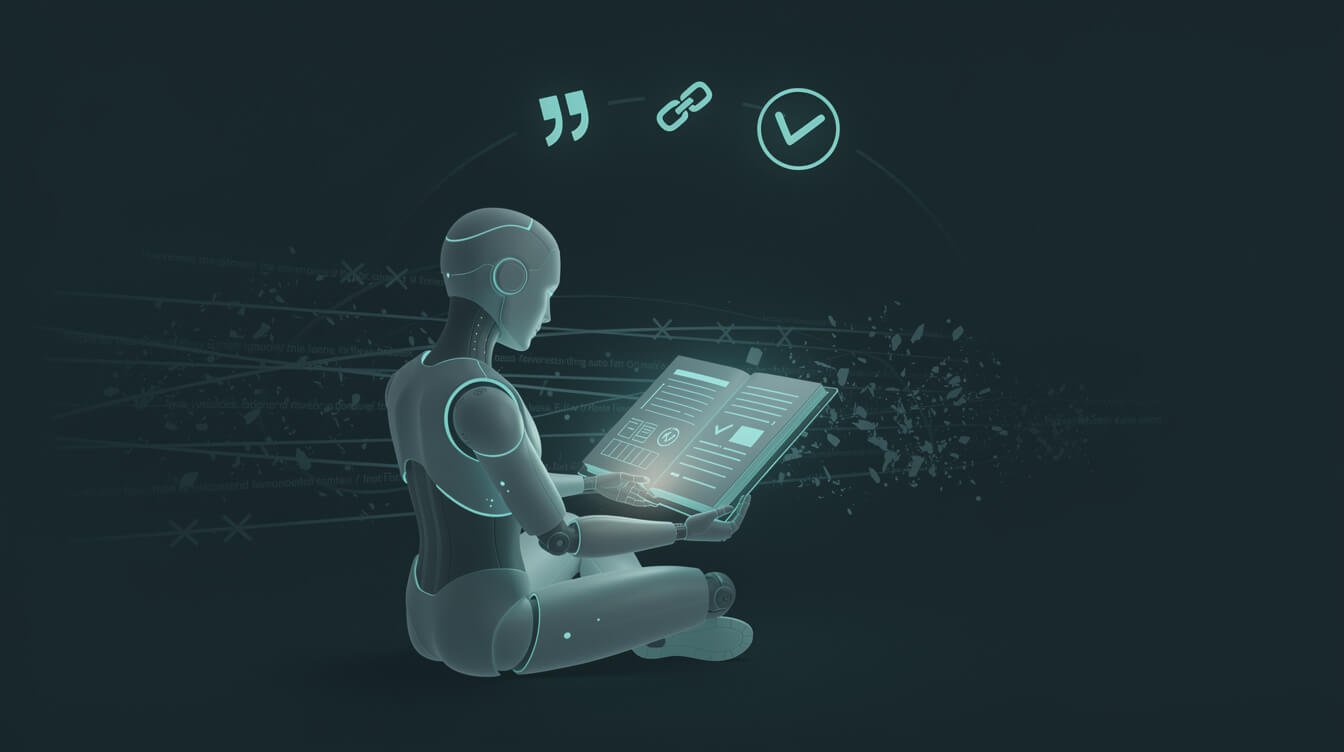
Here’s the quiet fear that stops most people from letting an AI agent do real work: what if it just makes something up? A confident, well-written, completely invented answer is the nightmare — because it doesn’t look wrong. Good news: you can stop your AI agent from making things up with three shortcuts I wire into every agent I run. None of them require code. All of them come down to one idea — never let the agent answer from memory when it can answer from a source.
Shortcut 1: Give it a facts file to quote from
An AI model left to its own devices will fill gaps with plausible-sounding guesses. So don’t leave a gap. Before an agent writes a word, I hand it a short “facts file” — a plain text or markdown doc with the real numbers, names, prices, and links it’s allowed to use. The instruction is blunt: “Only state facts that appear in this file. If it’s not here, say you don’t know.” Suddenly the agent isn’t inventing — it’s quoting. This is the same trick that turns a pile of notes into reliable agent memory: the file is the source of truth, and the agent reads from it instead of guessing.
Shortcut 2: Make “cite your source” a rule, not a hope
The fastest way to catch a made-up fact is to force the agent to show its work. I add one line to the prompt: “For every claim, name where it came from.” When an agent has to point at a source for each sentence, two things happen — it stops reaching for facts it can’t back up, and when it does slip, you can see it instantly because the citation is missing or vague. A claim with no source is a red flag you can spot in two seconds. No source, no trust.
Shortcut 3: Draft first, verify, then send
The cheapest insurance against a hallucination reaching a real person is a gap between “written” and “sent.” I never let a new agent publish or reply straight to the world. It drafts; I (or a quick second check) verify the facts against the source; then it goes out. Once it’s earned trust on a narrow job, I loosen the leash — but the draft-then-verify habit is exactly how you can eventually trust an agent to run without you watching. Where a wrong answer actually costs you money — like an AI agent answering your customers — this gap is non-negotiable.

⚡ GET THE AI EDGE
Weekly AI tips that actually save you time and money. No fluff, no hype — just what works.
The takeaway
Hallucination isn’t a mysterious flaw you have to live with — it’s what happens when you ask an agent to answer without giving it something to answer from. Ground it in a facts file, make it cite every claim, and keep a draft-then-verify gap before anything reaches a real person. Do those three and the “what if it makes something up” fear mostly disappears. If you’d like a second set of eyes on where your automations could quietly go wrong, book a strategy session and we’ll pressure-test it together.
— Jon

Get the free AI Playbook
The exact systems I use to run autonomous businesses solo. Straight to your inbox.
📥 FREE: THE AI PLAYBOOK
The exact tools and workflows I use to run a one-person agency. 25 years of marketing experience distilled into an actionable guide. Yours free.

AI & Digital Marketing Strategist
With over 25 years in digital marketing, e-commerce, sales, and international business, Jon Jones is a seasoned entrepreneur dedicated to empowering small businesses through innovative AI solutions. His journey began in investment banking on Wall Street, guiding companies through capital acquisition and complex markets, and has expanded to include expertise in web development, brand design, product development, and courses and training.
Fluent in Mandarin and with a rich foundation in both finance and tech, Jon launched JonJones.ai to provide accessible, transformative tools for small businesses to streamline operations, generate leads, and build sustainable growth. His mastery of AI, automation, and digital strategy has enabled numerous businesses to bridge the gap between traditional practices and modern technology, ensuring they thrive in today’s digital landscape.