

If you have spent any time in automation circles lately, you have seen the name everywhere — usually shouted by someone selling a course. So let’s answer the real question plainly: what is n8n, and is it actually the right tool for 你, or just the tool everyone is talking about? n8n (pronounced “n-eight-n,” short for “nodes”) is an open-source workflow automation platform that lets you connect apps, APIs, and AI models into automated pipelines — without writing much code, and without paying per-task ransom the way some closed platforms charge.
I run ten autonomous brands from a single VPS, and n8n does real work inside that fleet every single day. So this isn’t a feature-list rehash of the marketing homepage. This is an operator’s field guide: what n8n actually is, how it works under the hood, a real workflow from my own stack, and — the part nobody else will tell you — exactly when n8n is the 錯誤的 tool and you should reach for a Claude Code agent instead. By the end you’ll be able to decide in about two minutes whether n8n belongs in your business.
What Is n8n, Really? A Plain-English Definition

Strip away the jargon and n8n is a visual way to wire software together so tasks happen automatically. You drag boxes onto a canvas, connect them with lines, and each box does one job: fetch a row from a database, call an API, send a Slack message, ask an AI model to summarize something. When a trigger fires, your data flows down the line from box to box until the job is done. No cron scripts to babysit, no glue code rotting in a folder somewhere.
The word people fixate on is open-source, and for good reason. n8n is source-available software you can run on your own server, which means three things that matter to an operator: your data never has to leave infrastructure you control, you are not billed per task execution, and you can crack open any integration and change how it behaves. That’s a genuinely different posture from the SaaS automators that meter every step.
Here’s the honest framing, though. “Open-source and self-hostable” is a feature, not a personality. Plenty of people install n8n, marvel at the canvas for an afternoon, and never ship anything that survives contact with a real business. The tool is only as good as the workflow you have the discipline to design, test, and maintain. Keep that in the back of your mind as we go — it’s the difference between n8n being an asset and n8n being another abandoned tab.
If you want the head-to-head against the most common alternative before we go deeper, I wrote a full n8n vs Zapier operator’s verdict after running both in production. This guide is the “start here” companion to it.
How n8n Works: Nodes, Triggers, and the Mental Model
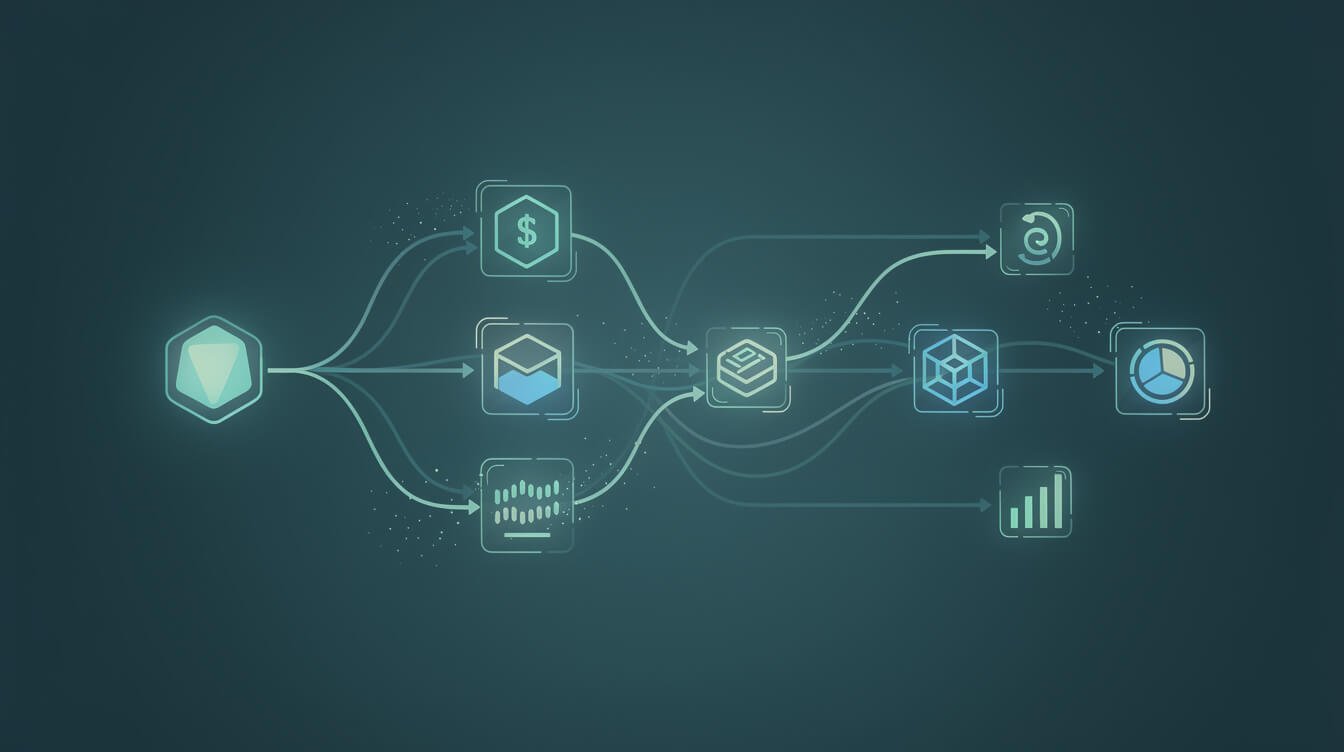
Once you understand three concepts, the whole platform clicks. Everything in n8n is built from these pieces, and they map cleanly onto how you’d describe a task to a new hire.
1. The trigger — what starts the workflow
Every workflow begins with a trigger node. It’s the “when this happens” clause. A trigger might be a schedule (every day at 6am), a webhook (someone submitted a form), an app event (a new email lands in Gmail), or a manual click while you’re building. Nothing runs until a trigger fires, which is exactly the mental model you want: automations are reactions to events, not programs you start by hand.
2. The nodes — each one does a single job
After the trigger, you chain 節點. Each node is a discrete action: an HTTP request, a database query, a data transformation, an “if” branch, a loop, or a call to an AI model. n8n ships with 400+ pre-built app integrations, but the one node that changes everything is the generic HTTP 請求 node — because it means any service with an API is fair game, integration or not. That single node is why operators outgrow closed platforms and never look back.
3. The data — it flows as items down the line
This is the concept beginners trip on. Data moves through n8n as a list of items (structured JSON), and each node receives the output of the node before it. If a node returns five items, the next node runs five times — once per item. Once that clicks, you stop thinking in scripts and start thinking in pipelines: input comes in, each stage transforms it, output goes out. It’s the same mental model behind good autonomous business systems generally — small stages that each do one thing well.
The AI piece bolts straight onto this. n8n has dedicated nodes for LLMs and “AI Agent” nodes that can call tools, so you can drop a model into the middle of a workflow to classify, summarize, or decide — then route the result to the next node. That’s how a simple automation graduates into something that feels intelligent.
A Real n8n Workflow From My JonOps Fleet (Receipts)

Enough theory. Here’s an actual n8n workflow that runs in my stack, because a definition you can’t picture in production isn’t worth much.
The job: when any of my brand containers publishes a blog post, I want the event captured, enriched, and fanned out to the right places without me touching anything. Here’s the graph, node by node:
- Webhook trigger — a brand container fires an HTTP call to an n8n webhook the moment WordPress confirms a post is live, passing the post ID and URL.
- HTTP Request node — n8n calls the WordPress REST API back to pull the full post: title, categories, featured image, word count. (That generic HTTP node again — no custom “WordPress plugin” required.)
- Set / edit fields node — reshapes the messy API response into a clean record: title, url, brand, published_at.
- Airtable node — appends that record to a “Published Posts” table so I have one source of truth across all ten brands.
- IF node — checks whether the post’s category is on my “repurpose” list. If yes, it continues; if no, the workflow ends quietly.
- Slack/Telegram node — pings me a one-line receipt: “[brand] published [title] — live.”
That’s it. Six nodes, no code beyond one small expression to format the message, and it has run hundreds of times without me opening the editor. The point isn’t the specific workflow — it’s the shape. A trigger, a couple of API calls, one branching decision, an action. Ninety percent of the useful automations a solopreneur needs look exactly like this.
Notice what n8n is 不是 doing here: it isn’t deciding what to write, judging quality, or handling anything ambiguous. It’s moving structured data along a fixed path. Hold that thought — it’s the entire basis of the decision framework coming up.

竊取我的人工智慧自動化策略手冊
The exact patterns I use to run ten autonomous brands from one laptop — n8n workflows, Claude Code agents, and the decision rules for when to use each. Free.
n8n vs Claude Code Agents: When Each One Wins (Beyond No-Code)

This is the section the marketing pages will never write, because it admits their tool has limits. After running both n8n and 克勞德代碼特工 in production, here’s the line I draw — and it’s simpler than the “AI agent” hype suggests.
Use n8n when the path is known. If you can describe the task as a flowchart — “when X happens, fetch Y, transform it, send it to Z” — n8n is the right, boring, reliable answer. Deterministic steps, fixed integrations, structured data. n8n will run that path a million times identically and never get creative. That reliability is a feature.
Use a Claude Code agent when the path is unknown. The moment a task requires judgment — reading a messy email and deciding how to respond, writing an article, debugging code, figuring out which steps to take rather than executing predefined ones — a rigid node graph fights you. That’s where an agent shines: you give it a goal and tools, and it decides the path at runtime. This is the real meaning of “beyond no-code”: not a fancier canvas, but handing the decision-making itself to the machine.
Here’s how the two actually combine in my stack, which is the pro move: n8n handles the plumbing, the agent handles the thinking. n8n triggers on an event and gathers data, hands it to a Claude agent for the judgment call, then takes the agent’s structured output and reliably fans it out. You get the agent’s intelligence 和 n8n’s dependable delivery. Neither tool is losing; they’re playing different positions.

⚡ 取得人工智慧優勢
每週提供真正省時省錢的AI小技巧。沒有廢話,沒有誇大其詞——只有切實有效的方法。.
If you have reached the ceiling of drag-and-drop automation and you want that thinking layer built into your business properly, that’s exactly the kind of system I design for clients. You can 預約自動化策略會議 and we’ll map where n8n ends and agents should begin for your specific stack.
Want to see the agent side in the wild first? My write-up on shipping real software with AI 以及我的 rundown of the MCP servers I actually run both show what “the thinking layer” looks like in practice.
Self-Hosted vs Cloud: The Honest Cost and Maintenance Reality

“n8n is free” is technically true and practically misleading, so let’s do the real math. You have two ways to run it, and the honest tradeoff is money versus responsibility.
Self-hosted (the community edition)
You install n8n on your own server — a $5–$20/month VPS handles a solo operator’s volume comfortably. The software license costs nothing. What it costs instead is ownership: you handle updates, backups, SSL, and the 11pm moment when a version bump breaks a workflow and there’s no support line to call. For a technical operator, this is a bargain and I recommend it. For someone who has never touched a terminal, “free” can quietly become the most expensive option in lost weekends. Be honest with yourself about which one you are.
n8n Cloud (managed)
n8n’s hosted plans start around $20–$25/month and climb with execution volume. You trade dollars for someone else handling uptime, updates, and infrastructure. For most solopreneurs who want the platform without becoming a part-time sysadmin, cloud is the sane starting point — prove the workflows earn their keep first, then decide whether self-hosting is worth the operational tax.
Either way, watch the pricing model as you scale: n8n meters by workflow execution, not per-task-step the way some competitors do. That distinction is a big part of why heavy-volume automators migrate to n8n — a workflow with twenty nodes still counts as one execution. I break the cost curves down further in my n8n vs Zapier comparison, and if you’re trying to build the skill deliberately, my operator’s take on AI automation courses covers what’s actually worth learning.
Who n8n Is Right For (and Who Should Skip It)

Let me save you a weekend. Here’s the honest sorting hat.
n8n is right for you if:
- You’re comfortable with APIs, JSON, and light technical setup — or you’re genuinely willing to learn.
- You want to own your automation infrastructure and data rather than rent it.
- You’re hitting per-task pricing walls on a closed platform and doing real volume.
- Your tasks are mostly 確定性 — known inputs, known steps, known outputs.
- You want a canvas that can call any API and drop AI models mid-flow.
You should skip n8n (for now) if:
- You need three simple Zaps and the thought of a VPS makes you tired — a friendlier closed tool will get you live faster.
- Your core problem is 判斷, not plumbing — that’s an agent job, not a workflow job.
- You won’t maintain it. An automation you don’t monitor is a liability with a countdown timer, a point I hammer on constantly when I talk about running an autonomous system responsibly.
The meta-lesson: the best automation tool is the one that matches the shape of your problem and your appetite for ownership. n8n is a phenomenal fit for the technical solopreneur who wants control and volume. It’s a frustrating fit for someone who wanted a magic button. Neither is wrong — just know which one you’re buying.
Want the workflow built for you?
I build and harden production automations — n8n, Claude Code agents, or the right blend of both — for operators who’d rather run the business than babysit the canvas.
What Is n8n Best For? Your Questions, Answered
What is n8n used for?
n8n is used to automate repetitive, multi-step tasks across apps and APIs: syncing data between tools, processing form submissions, sending notifications, scraping and enriching data, and orchestrating AI models to classify or summarize information. Anytime you can describe a task as “when this happens, do these steps,” n8n is a strong fit.
Is n8n free?
The self-hosted community edition is free to use — you only pay for the server you run it on (roughly $5–$20/month for a solo operator). n8n also offers managed cloud plans starting around $20–$25/month if you’d rather not host it yourself.
Do I need to know how to code to use n8n?
No, but a little technical comfort helps a lot. You can build many workflows entirely with the visual editor, but understanding APIs, JSON, and basic expressions unlocks the platform’s real power — especially the generic HTTP Request node that connects to any service.
Is n8n better than Zapier or Make?
“Better” depends on your priorities. n8n wins on data ownership, self-hosting, and execution-based pricing for high volume. Closed tools like Zapier win on polish and speed-to-first-automation for non-technical users. See my full n8n vs Zapier verdict for the operator’s breakdown.
Can n8n run AI agents?
Yes — n8n has dedicated LLM and AI Agent nodes that can call tools and make decisions inside a workflow. For fully autonomous, judgment-heavy work, though, a dedicated agent framework like Claude Code often fits better. The strongest setups use n8n for reliable plumbing and an agent for the thinking, as covered above.
Final Thoughts: Is n8n Your Next Move?
So, what is n8n? It’s a powerful, open-source, self-hostable workflow automation platform that connects your apps, APIs, and AI into reliable pipelines you actually own. It’s not magic, and it’s not for everyone — but for a technically comfortable operator who wants control, volume, and no per-task tax, it’s one of the best tools you can put in your stack.
The takeaway I’d tattoo on every new automator: match the tool to the shape of the problem. Deterministic, known-path work? That’s n8n’s home turf. Ambiguous, judgment-heavy work? Reach for an agent. Get that distinction right and you stop collecting shiny tools and start shipping systems that run while you sleep. That’s the whole game — and it’s exactly how one operator quietly runs an empire of autonomous brands.
Pick one boring, repetitive task in your business this week. Map it as a flowchart. If it’s a clean path, build it in n8n. You’ll learn more in that one afternoon than in a month of watching tutorials.
取得人工智慧自動化操作手冊
One operator, ten autonomous brands, one laptop. Join the newsletter and I’ll send you the playbook — the workflows, agents, and decision rules behind the whole system.
📥 免費:《人工智慧劇本》
我用來經營一人代理公司的所有工具和工作流程。 25 年的行銷經驗濃縮成一份實用指南。免費贈送。.

人工智慧與數位行銷策略師
Jon Jones擁有超過25年的數位行銷、電子商務、銷售和國際商務經驗,是一位資深企業家,致力於透過創新的人工智慧解決方案賦能小型企業。他的職業生涯始於華爾街的投資銀行,曾指導企業完成資本募集和應對複雜的市場環境。如今,他的專業領域已拓展至網站開發、品牌設計、產品開發以及課程培訓。.
Jon精通普通話,並在金融和科技領域擁有深厚的功底。他創立了JonJones.ai,旨在為小型企業提供易於使用且具有變革意義的工具,幫助他們簡化營運、拓展客戶並實現永續成長。他對人工智慧、自動化和數位化策略的精通,已幫助許多企業彌合了傳統模式與現代技術之間的鴻溝,確保它們在當今的數位化環境中蓬勃發展。.
相關文章
週三箴言:你無法觀察自主代理的行動——所以讓它告訴你它做了什麼。
經營自主代理最奇怪的地方在於:你幾乎看不到它們運作。我的代理程式在 Docker 容器內透過 cron 定時任務運行。它們喚醒、執行任務,然後再進入休眠狀態──…
AI SDR:它們的實際成本是多少,以及何時應該自己建造(2026 年)
當我跟每個創辦人聊起人工智慧銷售開發代表(AI SDR)熱潮時,他們都問同一個問題:它最終能否取代年薪7萬美元的銷售代表,讓他們以月薪500美元的價格成交?還是說它只是另一個華而不實的東西?
週一謠言:「Google會懲罰人工智慧內容」(我的代理商撰寫的部落格文章卻持相反觀點)
這裡有一個誤解,讓優秀的獨立創業家遲遲不敢發佈內容:「Google會懲罰人工智慧生成的內容,所以如果內容是機器人寫的,那就完蛋了。」這聽起來似乎合情合理,但實際上卻是錯誤的——而且它正在悄悄地讓人們付出代價…
常見問題星期五:個體創業家在使用人工智慧代理保護資料安全時常問的 5 個問題
歡迎來到「常見問題解答星期五」——在這裡,我會用簡單易懂的語言,回答大家透過電子郵件和私訊提出的真實問題,絕不推銷任何產品。本週的主題是大多數人都會忽略的問題…
週日準備:只需10分鐘即可完成隊列檢查,確保您的客服人員不會醒來發現工作空空如也。
星期天是貨櫃裡最安靜的一天。沒有部落格要發布,也沒有大型發表會——正好可以趁此機會確保下週的經紀人有事可做。因為這就是失敗之處…
週日準備:只需15分鐘的每週回顧,就能讓我的AI代理保持誠實
大多數人周日都在為週一的到來而焦慮。而我卻花了十五分鐘確保那台整週都在默默運轉的機器沒有出什麼岔子。關於自主代理,沒人會告訴你的是:“設定好它…”