You don’t need a social media manager. You don’t need to spend 3 hours a day crafting posts and refreshing analytics. What you need is a social media AI agent — an autonomous system that creates, schedules, and optimizes your social content while you focus on running your business.
Most small business owners treat social media like a chore. Post when you remember, ignore it for a week, then panic-post a batch of mediocre content. Sound familiar? AI agents change that equation entirely — and they’re more accessible than you think.
What Is a Social Media AI Agent?
A social media AI agent isn’t just a scheduling tool like Buffer or Hootsuite. It’s an autonomous system that handles the entire social media workflow — from content ideation to publishing to performance analysis — with minimal human input.
Think of the difference this way:
- Scheduling tool: You write the post, pick a time, hit schedule. The tool is a glorified calendar.
- AI assistant: You give it a topic, it generates a draft, you edit and approve. Still requires you at every step.
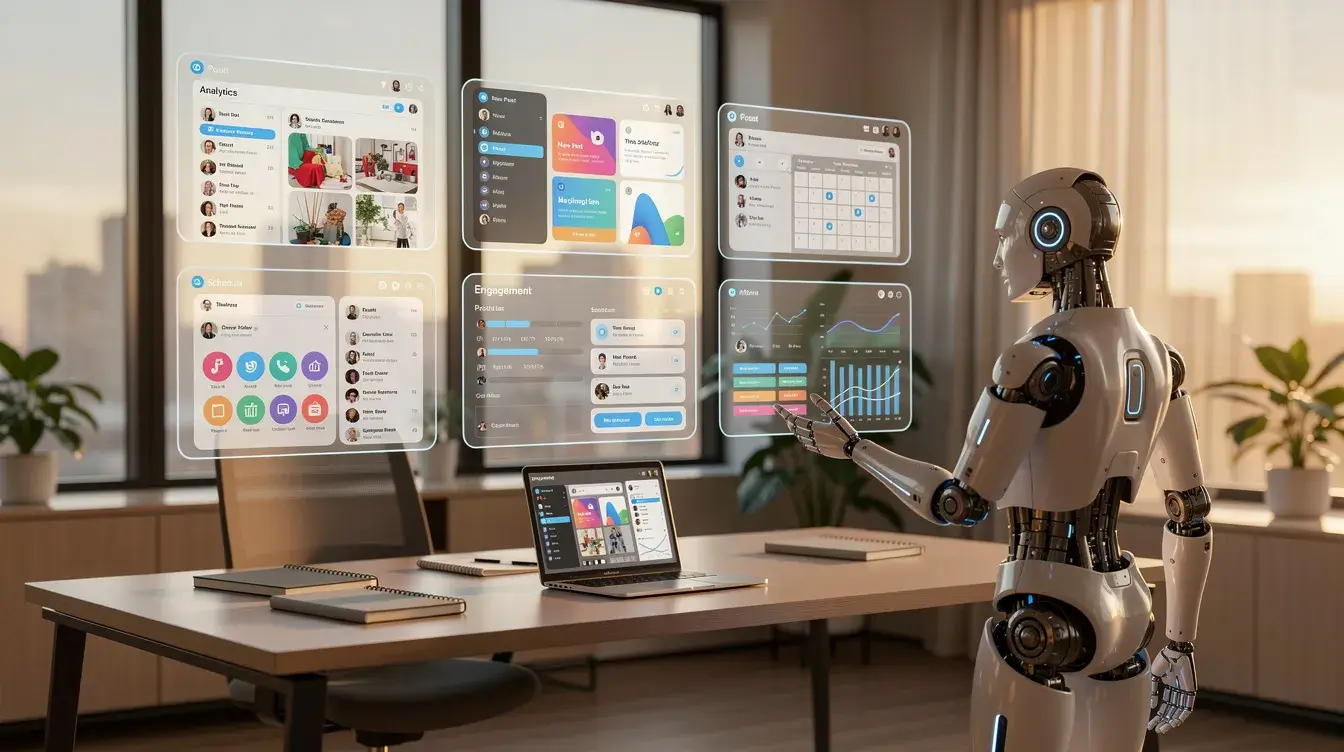
- AI agent: It monitors your content pipeline, generates platform-specific posts, schedules them at optimal times, analyzes performance, and adjusts strategy — autonomously within guardrails you define.
The key word is autonomous. An AI agent operates within boundaries you set, but it doesn’t wait for you to push buttons. It makes decisions, takes action, and reports results. You review the output on your schedule, not its schedule.
This isn’t science fiction. Companies like HubSpot, Salesforce, and dozens of startups are shipping social media agents right now. But you don’t need their enterprise pricing to get the same results.
Why Small Businesses Need Social Media Agents
Enterprise companies have entire teams managing social media. They’ve got content strategists, community managers, analytics specialists, and creative directors. You’ve got… you. Maybe a VA who posts when reminded.
Here’s the reality for most small businesses:
- Time cost: Creating quality social content across 4-5 platforms takes 10-15 hours per week. That’s a part-time employee you’re paying for with your own labor.
- Consistency problem: You post for two weeks, get busy with a client project, go silent for a month. Social algorithms punish inconsistency hard — your reach drops and takes weeks to recover.
- Platform expertise gap: What works on LinkedIn doesn’t work on Instagram. Every platform needs its own voice, format, and timing. Writing one post and blasting it everywhere is how you get ignored everywhere.
- Opportunity cost: Every hour spent writing tweets is an hour not spent closing deals, serving clients, or building products. The math doesn’t work.
A social media AI agent solves all four problems simultaneously. It runs in the background, maintains your posting schedule, adapts content per platform, and frees you to focus on revenue-generating work. If you’re still evaluating whether AI automation fits your business model, our guide on AI consulting for small businesses breaks down the real costs and benefits.
What a Social Media AI Agent Actually Does
Let’s get specific. A well-built social media AI agent handles these core workflows end-to-end:
- Content repurposing. You publish a blog post or record a video. The agent automatically generates platform-specific posts — a LinkedIn thought piece, a punchy tweet, an Instagram carousel caption, a Facebook summary, a Pinterest pin description. One piece of content becomes eight unique posts, each formatted for its platform.
- Scheduling and timing optimization. The agent analyzes when your audience is most active on each platform and schedules posts accordingly. No more guessing whether Tuesday at 9 AM or Thursday at 2 PM gets more engagement — the agent tests, learns, and adjusts.
- Hashtag and keyword research. Instead of manually searching trending hashtags, the agent identifies relevant tags based on your content, industry trends, and what’s driving engagement for competitors in your space.
- Performance analysis and strategy adjustment. The agent tracks engagement metrics across all platforms, identifies what content types and topics get the most traction, and shifts the content mix accordingly. More of what gets clicks, less of what falls flat.
- Community monitoring. Advanced agents flag comments that need your personal response — customer questions, complaints, partnership opportunities — while handling routine interactions and mentions automatically.
The difference between this and manually doing social media is the difference between driving stick and having a self-driving car. You set the destination and the rules. The agent handles the rest.
How to Set Up a Social Media AI Agent
You’ve got three practical approaches, depending on your budget and how technical you want to get:
Option 1: All-in-One Platforms (Easiest)
Tools like FeedHive, Buffer AI, and HubSpot’s Breeze agent are adding AI agent capabilities on top of their existing scheduling tools. These are the fastest path to value — sign up, connect your social accounts, and let the AI start generating content suggestions. Most offer free tiers or affordable starter plans.
The tradeoff: less customization, and you’re locked into whatever AI model they’ve integrated. The content can feel generic if you don’t invest time training the tool on your brand voice.

⚡ GET THE AI EDGE
Weekly AI tips that actually save you time and money. No fluff, no hype — just what works.
Option 2: No-Code Automation Stacks (Best ROI)
Combine workflow automation tools like n8n or Make with AI models (Claude, GPT-4) and a social scheduler like Metricool. You build a pipeline: blog post published → AI generates 8 platform-specific posts → posts scheduled across all channels automatically.
This is the approach we use at JonJones.AI. Every blog post we publish triggers an automated workflow that generates tailored content for LinkedIn, Twitter/X, Facebook, Instagram, Threads, Pinterest, Bluesky, and Google Business Profile — each written in the appropriate style and length for its platform. The total cost is about $30-50/month in tool subscriptions plus minimal API costs.
Option 3: Custom AI Agent Build (Maximum Control)
For maximum control, build a custom agent using tools like Claude Code, LangChain, or CrewAI. The agent monitors your content calendar, generates posts using your exact brand voice, and publishes through platform APIs directly. This requires some technical ability but gives you an agent that truly understands your business. Our Claude Code tutorial walks through the basics of building AI-powered automations.
What This Looks Like in Practice
Here’s a concrete example of how a social media AI agent works in a real business workflow:
You publish a 2,000-word blog post about email marketing automation at 8 AM. By 8:05 AM, your AI agent has:
- Read the full post and identified the three most compelling points
- Written a LinkedIn post (200 words) framing the topic as a professional insight with a question to drive comments
- Written a Twitter/X thread (5 tweets) pulling the most quotable stats and tips
- Written an Instagram caption (150 words) with relevant hashtags and a call-to-action
- Written a Facebook post (100 words) with a conversational hook
- Created a Pinterest pin description optimized for search within the platform
- Scheduled everything at each platform’s optimal posting time for your audience
Total time spent by you: zero minutes. The agent handled the entire pipeline from content detection to publishing. You glance at the scheduled posts during your morning coffee, approve or tweak anything that needs it, and move on with your day.
That’s not theoretical. That’s what AI agents for small business do right now, today, with tools that cost less than a single freelancer’s hourly rate per month.
Best Tools for Building a Social Media AI Agent in 2026
The tool landscape is evolving fast, but these are the most reliable options for small businesses right now:
- Metricool — Multi-platform scheduler with analytics. Supports Instagram, Facebook, Twitter/X, LinkedIn, Pinterest, TikTok, YouTube, Google Business Profile, and Bluesky. Strong free tier. This is our go-to for scheduling.
- n8n — Open-source workflow automation. Self-host for free or use their cloud plan. Connect your AI model to your scheduler and let content flow automatically. More powerful than Zapier for complex workflows, and significantly cheaper.
- FeedHive — Purpose-built AI social media tool with content recycling, conditional posting, and AI-generated suggestions. Good if you want an all-in-one solution without building custom automations.
- Claude or ChatGPT — The AI brain behind your agent. Use either through their API to generate platform-specific content. Claude tends to produce more natural-sounding text. ChatGPT has wider plugin support.
- Buffer AI — The classic scheduler now with AI content generation built in. Simple interface, reliable posting. Best for solo operators who want minimal complexity.
The winning combination for most small businesses: Metricool + n8n + Claude API. Total cost under $50/month. Handles 8 platforms. Runs autonomously. Scales with your business without scaling your workload.
5 Mistakes to Avoid With Social Media AI Agents
- Setting it and forgetting it completely. AI agents need guardrails and periodic review. Check in weekly to make sure the content still sounds like you and aligns with your current business focus. An agent running without oversight eventually drifts off-brand.
- Using the same content everywhere. A good agent writes different content for each platform. If your LinkedIn post is identical to your tweet, you’re undermining the whole point. Platform-native content consistently outperforms copy-paste by 3-5x in engagement.
- Ignoring brand voice training. Feed your agent examples of your best-performing content. Give it explicit style guidelines — words you use, words you avoid, your typical sentence length. The more context it has about your voice, the less it sounds like a robot.
- Skipping the human touch entirely. Let the agent handle the 80% — routine posts, scheduling, hashtag research, analytics. But jump in personally for replies to thoughtful comments, hot takes on industry news, and genuine relationship-building. That’s where trust gets built.
- Over-automating engagement. Auto-replies and bot comments get flagged, reported, and ignored. People can smell automated engagement from a mile away. Use AI for content creation and distribution. Keep genuine interactions human.
Getting Started This Week
Here’s a practical roadmap to get your first social media AI agent running:
- Audit your current workflow. How many platforms are you active on? How much time do you spend per week on social media? What’s your biggest bottleneck — coming up with content ideas, actually writing posts, scheduling, or analyzing what works?
- Pick your stack. For most small businesses, start with Metricool or Buffer for scheduling, plus ChatGPT or Claude for content generation. If you want full automation, add n8n or Make to connect everything into a hands-off pipeline.
- Create your brand voice document. Write down 5-10 examples of posts that sound like you at your best. Include words you always use, phrases you’d never say, and your typical tone. This becomes the AI’s style guide and dramatically improves output quality.
- Start with one platform. Don’t try to automate everything at once. Pick your highest-value platform — LinkedIn for B2B, Instagram for B2C, Twitter/X if you’re in tech — and get the agent producing consistent, on-brand content there first.
- Scale after 2 weeks. Once the content quality is dialed in on one platform, expanding to others is the easy part. The hard work is getting the voice right. Multi-platform distribution is just connecting more outputs.
Stop Posting Manually. Start Building Systems.
Social media isn’t going away. The businesses that win aren’t the ones posting the most — they’re the ones with systems that run without constant attention. A social media AI agent turns your content strategy from “post when I remember” into a consistent, optimized, multi-platform operation that runs whether you’re at your desk or on a beach in Bali.
The tools exist right now. The setup takes hours, not months. And the ROI — 10-15 hours per week back in your schedule — starts immediately.
Ready to automate your social media and reclaim your time? Explore our AI automation services or pick a tool from the list above and start building your first agent today. Your future self will thank you.
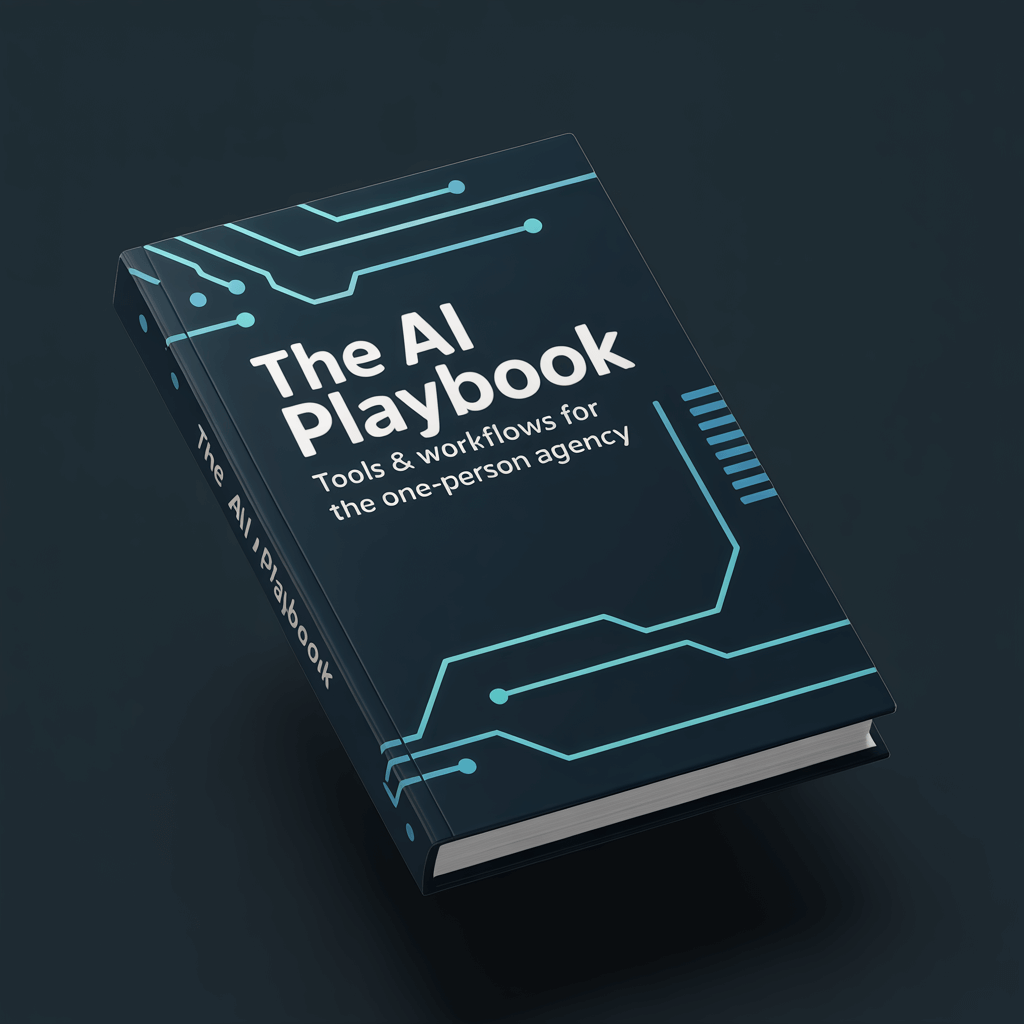
📥 FREE: THE AI PLAYBOOK
The exact tools and workflows I use to run a one-person agency. 25 years of marketing experience distilled into an actionable guide. Yours free.

AI & Digital Marketing Strategist
With over 25 years in digital marketing, e-commerce, sales, and international business, Jon Jones is a seasoned entrepreneur dedicated to empowering small businesses through innovative AI solutions. His journey began in investment banking on Wall Street, guiding companies through capital acquisition and complex markets, and has expanded to include expertise in web development, brand design, product development, and courses and training.
Fluent in Mandarin and with a rich foundation in both finance and tech, Jon launched JonJones.ai to provide accessible, transformative tools for small businesses to streamline operations, generate leads, and build sustainable growth. His mastery of AI, automation, and digital strategy has enabled numerous businesses to bridge the gap between traditional practices and modern technology, ensuring they thrive in today’s digital landscape.